
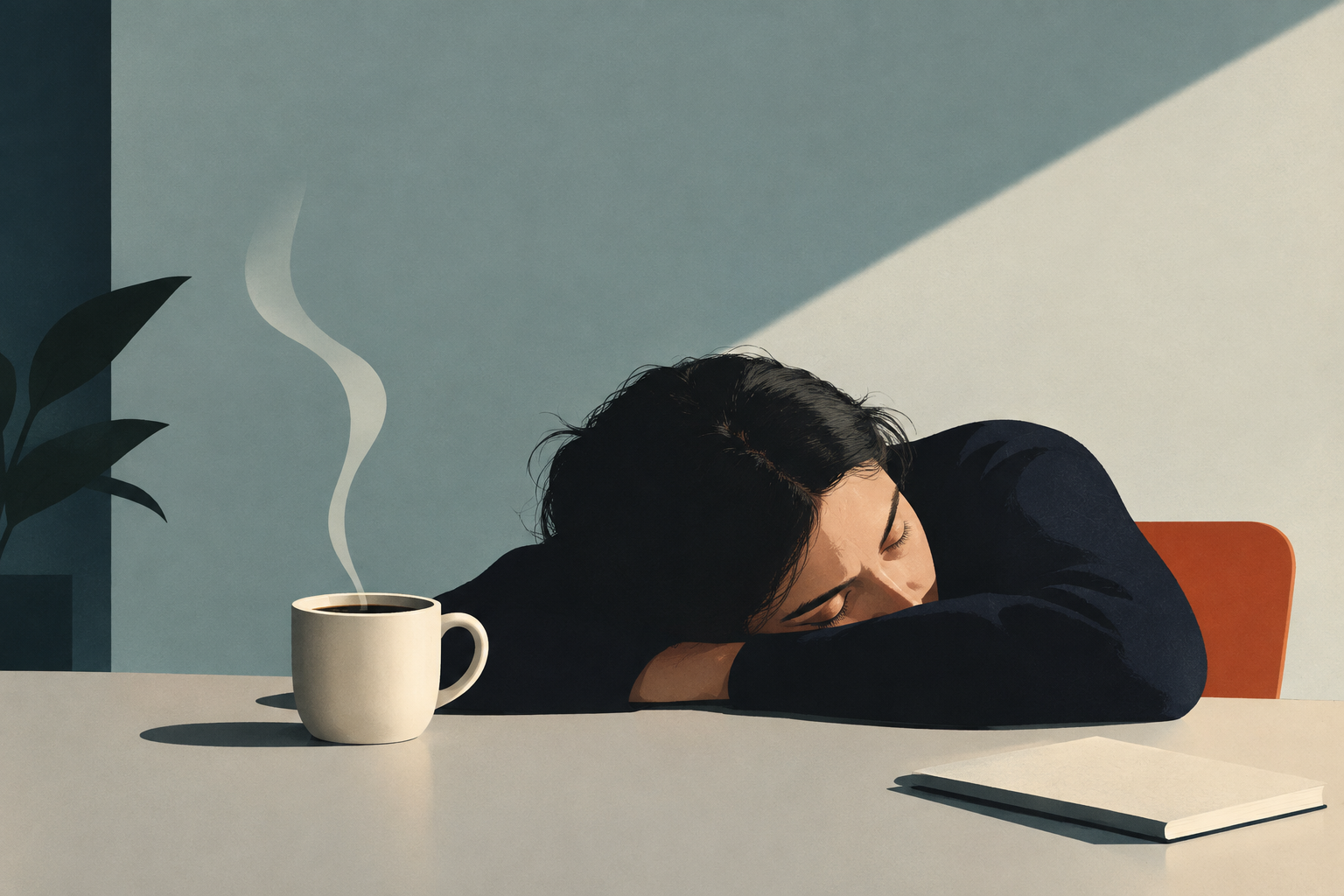

What if the best way to take coffee isn’t by drinking and staying up, but by drinking and then going to sleep?
It sounds crazy, because coffee is supposed to wake you up while sleeping does the opposite. However, if you combine the two in the right order, you may be able to achieve something truly remarkable: you may wake up feeling better than you would have if you had taken either coffee or a nap on its own.
Scientists have been studying this bizarre concept for years. It is called a coffee nap and also commonly as, a “nappuccino“.
Now, here is some science to back up this strange concept.
What is a coffee nap?
Well, it‘s actually almost absurdly simple.
Drink coffee, take a (short) nap immediately afterwards, and wake up about 20 minutes later, refreshed.
The timing is important.
You aren‘t going to go and get your coffee, scroll through social media for an hour, and then take a nap. You’re going to consume your coffee and then immediately go lay down for a quick power nap, preferably between 15 and 20 minutes.
Why should I do this instead of just drinking a cup of coffee?
There‘s a little science to back up why a nap and coffee combo might work. However, why would drinking coffee specifically before taking a nap work ?
Picture in your head an internal “sleepiness” gauge in your brain.
During the day, while you are awake, your brain is constantly producing a neurotransmitter called adenosine that binds to your brain’s adenosine receptors, causing you to feel sleepy. Caffeine has an effect on the body by blocking the binding of adenosine to the adenosine receptors. Since caffeine molecule has a similar chemical structure to adenosine, caffeine binds to its receptors that prevent adenosine from binding and consequently preventing from becoming more sleepy.
But what happens if I take a nap after my coffee?
A short nap would help might help with the irresistible urge to sleep after being awake for a long time.
Adenosine builds up throughout the day, causing you to feel sleepy.
↓
Your caffeine intake prevents some of that adenosine binding to your brain receptors (since caffeine molecule is structurally similar to adenosine)
↓
You take a short nap to help reduce the built sleepiness load and your overall adenosine levels
↓
You wake up as the caffeine is kicking in.
So you get a double benefit: reducing overall sleepiness and boosting your wakefulness. Not quite as fun as that viral post, but there’s some science behind it!
Research showed that combining a short nap with caffeine consumption has displayed increased alertness as compared to the effect of either one separately.
Why should my nap be 20 minutes long?
Why not let it go for an hour?
Well, there‘s a point where the longer you nap, the less benefit you get. Short naps of 15-20 minutes are usually best for boosting your alertness. A nap of longer than 30 minutes could leave you feeling more groggy and tired when you wake up.
Also, napping for more than 30 minutes is usually considered entering into the deeper stages of sleep, and waking up from those stages leaves you with something called sleep inertia– a state of grogginess and disorientation when you wake up that can last for several minutes or even hours.
Thus, the coffee nap is not a method of obtaining a full nights sleep in a short time. The caffeine is also beginning to take effect at this point. The recommended time for a coffee nap, according to the Sleep Foundation, is 15–20 minutes. It is entirely possible that you will not fall asleep, and even then, it might not help you.
Do they actually work?
It is now time to take off the rose colored glasses.
Coffee naps are not a scientifically proven method of overcoming post lunch torpor. There has been little scientific research into coffee napping, and the experiments that have been conducted have had miniscule sample sizes.
For example, the most frequently referenced study on coffee napping, published in 2003, experimented on a sample size of 10 young healthy adults. Researchers tested various methods for overcoming post-lunch sleepiness, including a 20 minute nap, caffeine plus a nap, bright light, and face washing.
Another study with university students also included only 10 participants and compared coffee, napping sessions, coffee followed by sleeping and taking a quiet break. The researchers found improvement for several variables with the coffee-nap treatment.
There are also studies on the effects of caffeine and naps in situations involving sleep deprived drivers and night shift workers which suggest that both caffeine and napping can be beneficial in terms of reducing sleepiness during demanding situations.
So the conclusion is not that “science shows that coffee naps work“
It is more like a few experiments suggest that caffeine + a short nap might be helpful, but we need more studies to know when and what condition it should be done in order to be effective.
Right? It makes more sense.
How to do a coffee nap
Well if you are interested just simply follow this little experiment:
- First drink your coffee
- Set an alarm for about 20 minutes after
- Sit down or lay down right after
- Take a short nap
- And wake up when the caffeine kicks in
But remember the amount of caffeine in a cup of coffee varies from one coffee shop to another. A few studies on coffee naps included about 200 mg of caffeine. Consider it an experiment.
When a coffee nap could be a bad idea
One major problem with the coffee nap is that caffeine doesn’t care that you only want to use it to perk yourself up. It can last in your system for hours and wreak havoc on your night’s sleep. Studies have shown that consuming caffeine too close to bedtime can lead to reduced sleep quality, and individuals can vary significantly in their sensitivity to it.
So if you’re already having trouble sleeping at night, afternoon caffeine may solve one issue while subtly creating another. If coffee leaves you jittery, anxious, with a pounding heart, or just generally unable to wind down, then a coffee nap probably isn’t for you.
Most importantly, a coffee nap isn’t a solution for chronic, relentless daytime sleepiness – if you’re always battling a wave of lethargy no matter how much sleep you get, speak to a medical professional instead of trying to fight it with caffeine and a nap.
The Bottom Line
The concept of a coffee nap seems like an oxymoron; drinking a stimulating beverage and then immediately going to sleep. However, as previously explained, once you break it down, the idea isn’t so shocking.
Taking a short nap helps to clear away some of your adenosine, while the caffeine plug some of those sleepiness receptors.
While there isn’t conclusive evidence to state that coffee naps are a miracle elixir for tired workers, there are some small-scale studies that show promise in this burgeoning field.
So next time you’re falling victim to the afternoon lull, you could always participate in a rather scientific experiment
Have your coffee, set the timer, and let your caffeinated beverage do the heavy lifting while you take a quick nap.