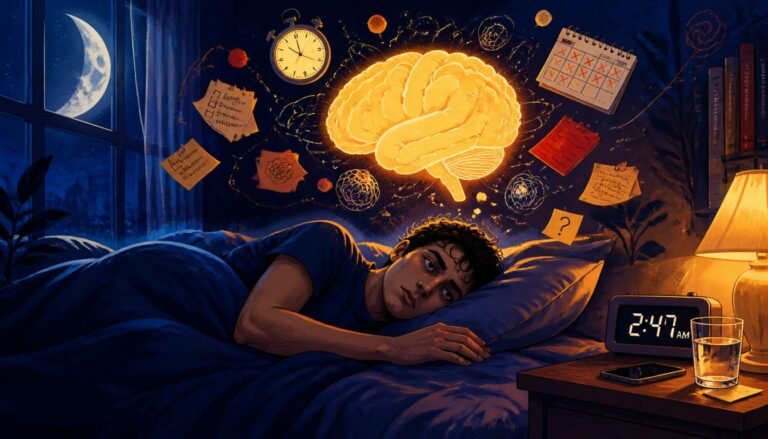
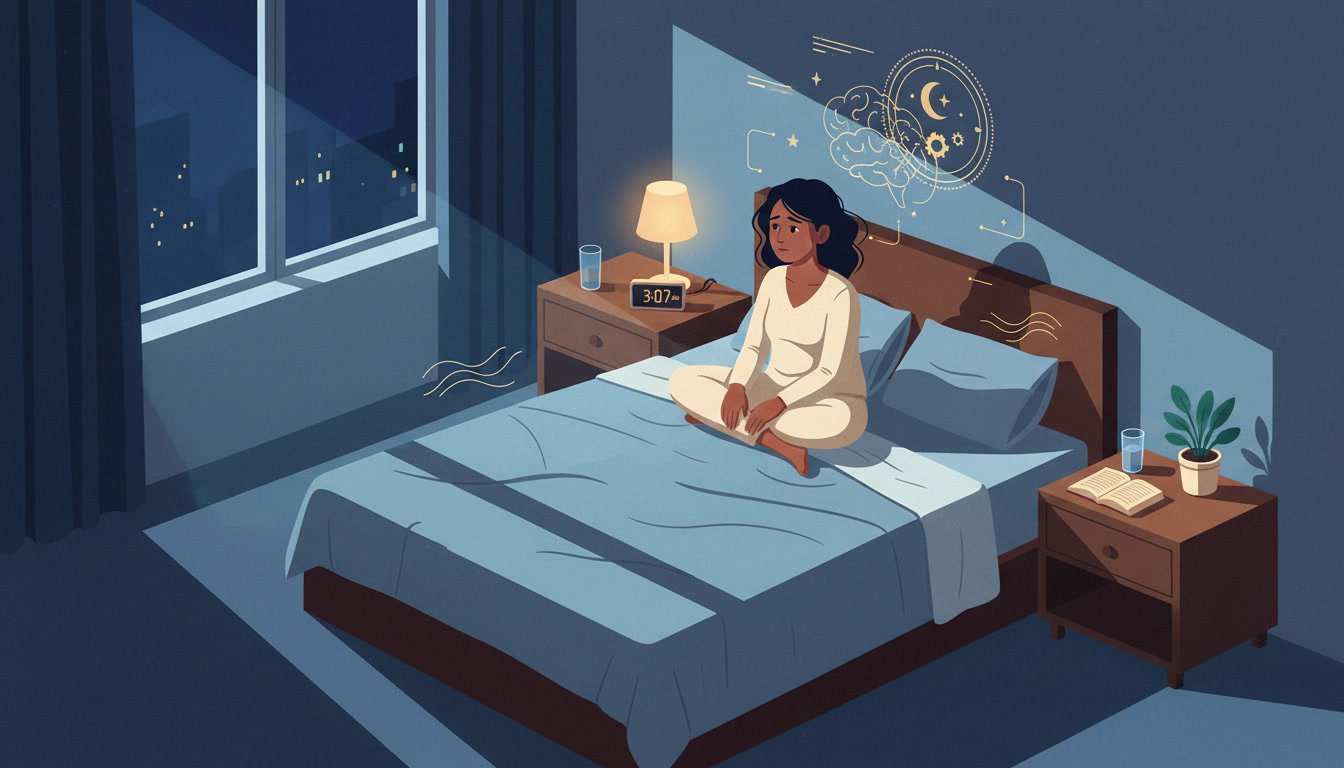

You finally fall asleep. Perhaps you were so exhausted that you could hardly touch the pillow before you closed your eyes.
Then, you suddenly find yourself staring at the clock in the middle of the night.
It’s 3:07 a.m.
You roll over and try to go back to sleep, but as you do, you realize that you’re more aware of your surroundings than you were a few minutes ago. It occurs to you that you should be asleep, so you wonder, why do I keep waking up at night?
When it comes to sleeping, it’s important to remember that you can’t sleep for 8 hours straight. Your brain actually cycles through different stages of sleep, and you may have woken up briefly in between. You just don’t remember it, since you fall back asleep almost immediately.
The more interesting question is what happens after you wake up.
Why can one person roll over and fall asleep again, while another ends up staring at their ceiling for an hour?
There are several possible explanations, and they’re not all medical.
First: Is waking up in the night actually normal?
Think of sleep as more of a train with lots of stops, rather than a switch with one on/off position.
During the night, your brain actually cycles through different stages of non-REM and REM sleep, with each cycle averaging about 80 to 100 minutes in length. Most adults only get a few full cycles per night so they tend to get more deep sleep early in the night and more REM sleep later in the night. There can also be brief periods of waking in between these cycles.
So, if you fall asleep briefly, open your eyes, change position, notice the surroundings, and fall asleep again quickly, and do this several times without thinking about it, this is usually nothing to worry about.
The situation changes if you have trouble falling asleep, staying asleep, or wake up too early and simply cannot go back to sleep.
So, the questions that arise are no longer ‘Why did I wake up?’ but rather ‘Why can’t I fall asleep?’. Insomnia, for instance, is a sleep problem characterized by difficulty falling asleep or waking up throughout the night or too early in the morning and being unable to fall back asleep. The issue should be discussed with a doctor if sleep difficulties begin to interfere with daytime functioning or cause emotional or physical discomfort.
In other words, the fact that you wake up at night need not necessarily be the problem: it’s all about patterns and how they affect your daily life.
Your Body Clock May Be Part of the Story
Humans possess an internal set of body clocks which are also known as their circadian rhythms. These have been likened to an inbuilt timing system.
The rhythms help to control your patterns of sleep and wakefulness, and also your ability to perform different tasks at different times of the day, as well as being involved in numerous other processes. Light and darkness play an important part in regulating the body clock.
And here is another thing: your body does not have the same amount of “sleep pressure” throughout the whole night.
As it gets closer to morning, your body actually starts to prepare you to wake up. That is why you feel less and less sleepy as the night goes on — and it is not because your brain decides, “Hey, it is already 3 am, I should stop letting this poor guy sleep.”
Your brain is probably responding to a complex mix of sleep pressure, your circadian rhythm, your environment, and your body chemistry.
That is also why you might find yourself waking up in the middle of the night after having had a few hours of deep, consolidated sleep — there is nothing wrong with your body clock, your body is simply telling you to wake up.
So, What Is Waking You Up, Then?
Well, it could be something external — or it could be something internal.
Sometimes it is even your body doing it — but not your circadian rhythm, mind you. These are 7 most common sleep disruptors.
1. Your Sleep Environment Is Disrupting Your Sleep
Your brain does not really “shut down” when you fall asleep — and that means that any noise or disturbance can wake you up or make you less likely to fall asleep in the first place.
A car passing by outside your window, your dog barking, your girlfriend tossing and turning, your cat jumping on the bed, the room slowly getting warm — these are all disruptions.
Even if they do not wake you up, they prevent you from having a deep and restorative sleep.
This is why improving sleep quality is often less a matter of complicated sleep tactics and more a matter of cooler, darker, quieter, and more comfortable bedrooms.
Your sleeping brain is not asleep.
2. Caffeine, Alcohol, or Nicotine May Be Present
That afternoon cup of coffee may have more far-reaching effects than you realize.
Caffeine is a stimulant, and its effects can linger in the body for hours. NHLBI notes that the effects of caffeine can last up to about eight hours in some people. The stimulant effects of nicotine can also disrupt sleep.
Alcohol is a bit more complex.
You may feel that a drink makes you sleepy and at first, it can. However, alcohol can also make sleep lighter and more likely to wake up during the night.
Now here’s the thing you need to know:
What helps you fall asleep isn’t necessarily what helps you stay asleep.
If you’re having trouble staying asleep through the night, consider what you’re doing in the afternoon and evening.
3. Your Sleep Schedule–or Your Naps–May Be Working Against You
Your brain wants predictability.
If you go to bed at midnight on weekdays but stay up until 2 or 3 a.m. weekends and then sleep until late morning on weekends, it’s harder to return to your regular sleep pattern during the weekdays. This can wreak havoc on your natural circadian rhythms.
Meanwhile, long or untimely naps can rob you of the sleep pressure you need to feel sleepy at night.
Napping isn’t necessarily a bad thing. In fact, it can help. But if you have a hard time sleeping through the night, especially if you’re napping too late in the day, experiment with when you take your nap to see how it affects your ability to sleep at night.
Having a consistent bedtime and wake-up time can help your body stick to a sleep schedule. The NHLBI also advises limiting naps—especially in the afternoon—if you have trouble sleeping at night.
Think of it as a regular schedule for your brain rather than asking it to calculate bedtime.
4. Your Brain Is Wide Awake With Stress
Sound familiar?
You’re jolted awake to take care of business, but then you remember an email you need to send tomorrow.
You think about the meeting.
The money issue.
Something embarrassing you did three years ago.
At 3 a.m., apparently, your brain has decided that a board meeting would be a good idea.
Stress and worry can contribute to insomnia, and worrying about whether you’ll get enough sleep can exacerbate the problem. Clock-watching can create a similar feedback loop: It’s 3:15. I need to be asleep. Now it’s 3:30. Tomorrow is going to be terrible.
That can be hard on the nerves.
This is one reason nighttime waking can become self-perpetuating. The initial provocation can be minor: a noise, a dream, a transition from one stage of sleep to another. But once you’re awake, the thought that you might not be able to fall back asleep can keep you from doing so.
5. Something Physical Is Interrupting Your Sleep
Your body can have other ideas about when you should be asleep.
Pain can prevent you from falling asleep or cause you to wake up more easily during the night. Indigestion can be especially bothersome when you’re lying down. So can the need to urinate.
Eating too close to bedtime can also cause heartburn or indigestion. If you have GERD, you may find it helpful to eat at least 3 hours before bedtime.
There are several other possible reasons you may be headed to the bathroom multiple times during the night. Of course, drinking lots of fluids late in the day is a simple explanation, but if it’s happening often it might be worth speaking with your doctor, instead of just blaming it on bad sleep.
The more important point is that sometimes the issue isn’t with your sleep at all.
What I mean is, your sleep may be responding to something else going on in your body
6. Hormones Can Impact Your Sleep
Your hormones can impact your sleep, and imbalances can sometimes cause you to have more difficulty sleeping at night. For instance, menopause can cause hot flashes and night sweats, as well as issues falling asleep or returning to sleep after you wake up in the middle of the night.
Pregnancy and other hormonal issues can affect sleep patterns.
That does not mean that every nocturnal awakening should be blamed on hormones. However, if your sleep seemed to have changed around the same time that another physiological change took place, it is worth looking into with a medical professional.
7. A Sleep Disorder Can Cause You to Waken Up Repeatedly
Sometimes the culprit is something that needs more attention.
Sleep apnea can cause people to stop breathing for short periods while they are asleep. The person might not even realize it, because they might not remember wake ups during the night. Others will be aware of it, if they hear the snoring, gasping, choking, or moments of stopped breathing.
Another possibility is that the patient suffers from restless legs syndrome (RLS).
Patients suffering from RLS experience uncomfortable sensations in the legs such as crawling, pulling, aching, or itching, and they have an urge to move their legs to relieve these sensations. These sensations are often more severe during rest and in the evening or night and make sleeping difficult.
These conditions are certainly not the reason for every sleepless night, but if you’re having repeated nights of trouble sleeping (particularly when accompanied by issues such as difficulty breathing, strange sensations in your legs, or excessive daytime drowsiness), it’s probably worth looking into beyond just trying to count sheep.
Why do I keep waking up at night especially around 3 AM?
There is something oddly specific about the witching hour.
Many people have noticed that they seem to always wake up at around the same time during the night, and it makes them wonder if there isn’t some deep meaning to it.
However, there isn’t actually a specific reason why you might wake up at 3am more often than any other hour. The simplest explanation is that you simply fall asleep at a later hour than you think.
Sleep cycles change throughout the night; your body isn’t on a strict 8 hour schedule, and you don’t spend all 8 hours asleep in a deep, restful sleep. Furthermore, your circadian rhythms are also starting to shift you towards being awake as morning approaches.
Then add the environment.
Your heating system could be kicking on at a particular time every night; your spouse’s tossing occurs before they ever get up for their morning jog. You drank sufficient water in the evening that your bladder can reliably get your attention hours later.
Or perhaps you are beginning to recall the awakenings that happen at a significant time.
If you wake for a brief moment at 1:12 a.m., then fall instantly back to sleep and do not think about it for the remainder of the night, it’s no big deal. But if you wake at 3:00, check the clock, and spend the next 45 minutes awake, that’s a different scenario.
A pattern can become increasingly apparent over time.
So if you’re having recurring awakenings around 3 a.m., don’t jump immediately to a conclusion about a specific biological significance of that hour.
Ask yourself something more productive:
What typically happens around that time of night?
What Should I Do If I Wake Up?
The first principle is actually quite simple: if you wake for even a little while, do not do anything that will make you more awake.
If you’re wide awake, it’s important to stay in bed, but it’s equally vital that you keep things as boring as possible.
So no checking the clock, or using your cell phone, or getting up and making yourself a cup of tea, or turning on the reading light unless you’re going to stay up for a while (in which case, you should probably leave the bedroom and do some relaxing activities in dimly lit areas until you feel sleepy again). And certainly no obsessing over how many hours’ sleep you are going to lose if you manage to fall asleep right this second, since all of these thoughts will make you more awake. Instead, try to keep the room dark and quiet and give yourself a chance to slowly fall back asleep. Sometimes just lying there quietly and focusing on your breathing can be enough.
If you’re clearly awake and attempting to fall asleep for more than 20 minutes without success, sleep specialists will often tell you to get up and do some mildly stimulating and relaxing activities in dim lighting until you feel sleepy again, then return to bed. This is a form of behavioral therapy called stimulus control.
During the day, focus on the areas that have been shown to improve sleep:
- Keep your sleep and wake times roughly consistent.
- Get regular daytime exercise
- Avoid caffeine and nicotine, especially in the evening.
- Limit alcohol consumption, especially close to bedtime.
- Keep your bedroom cool, dark, and quiet.
- Short naps can help if you have trouble sleeping at night, but try to keep them under an hour and earlier in the day.
- Finally, give yourself a little downtime to relax before bed.
It’s probably not worth trying to think about what makes up a perfect bedtime routine. What you need most is a routine that your brain can recognize.
When Is Nighttime Waking Something to Investigate?
Occasional nighttime waking is normal during your sleep. However, it’s worth looking into if it’s having a negative impact on your daily life. You may want to consult with a medical professional if you have a situation including:
- Waking up frequently during the night for extended periods of time.
- Waking up at night is interfering with your daily life.
- You feel very sleepy during the day.
- You snore very loudly, gasp, choke, or seem to stop breathing during sleep.
- Waking up because of pain, reflux, needing to go to the bathroom, restless legs, hot flashes, or another bothersome problem that occurs repeatedly.
Having trouble sleeping is also a possible symptom of insomnia. According to the NHLBI, chronic insomnia is trouble sleeping at least 3 nights a week for 3 months or more, with daytime consequences, when not caused by something else.
You don’t have to guess what’s wrong with you.
Keep a sleep diary for a week or two and you’ll be amazed how much simply writing it down can help. Keeping track of bedtime, wake-up time, any naps, caffeine and alcohol consumption, exercise, and how you feel during the day can add up to a powerful troubleshooting tool.
Your Body Isn’t Supposed to Sleep Like a Switch
Sleep isn’t a straight eight-hour block, you know.
Your brain cycles through different stages of sleep, and your body’s reaction to light, heat, hormones, stress, drugs, physical discomfort, and the environment can all play a role. You can also experience very short periods of wakefulness during the night. And you may not even realize it.
Waking up even once or twice during the night doesn’t necessarily mean you have a sleep disorder. But frequent interruptions and difficulty returning to sleep can be an indication of something’s wrong, not just with your sleep, but with your life.
It could be caffeine, an irregular sleep schedule, or a noisy bedroom. It could also be something more. And there are many things you can do about it.
So the next time you wake up at three in the morning, ask yourself. What could be waking me up–and what should I do about it rather than something’s wrong with my sleep.