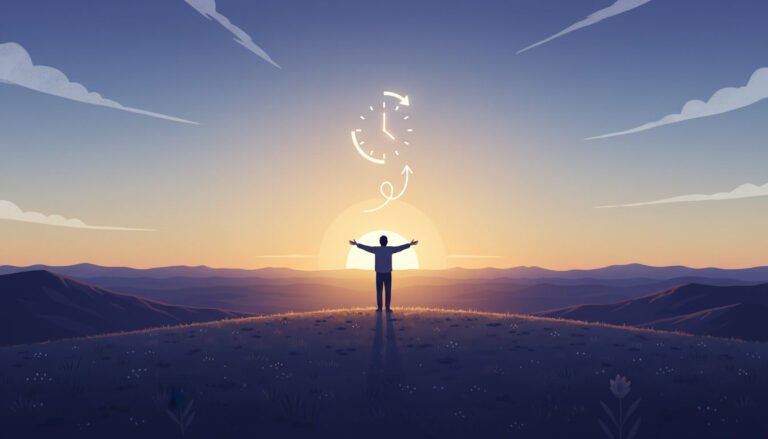

Have you ever noticed that you start feeling sleepy around the same time every night, even when nobody tells your body that it’s bedtime?
Perhaps you wake up a few minutes before your alarm clock goes off or perhaps you get an overwhelming sense of sleepiness at about the same time every afternoon.
Somehow, your body keeps track of this time of day.
What’s interesting is that your body doesn’t need a clock to tell it roughly what time it is.
Your brain, hormones, organs, and even individual cells maintain some sort of internal ”body clock”. Systems within your body control your daily patterns ranging from digestion to sleep cycles.
Your circadian rhythm is not a little clock in your brain. It is a biological timekeeping system that is constantly fine-tuned and updated based on the signals it receives from your environment.
Now, how does your brain process sunlight, darkness, mealtimes and other signals into a sort of biological timetable?
The answer lies in the concept of your circadian rhythm.
What Is A Circadian Rhythm?
The word circadian roughly translates to “about a day.”
A circadian rhythm is basically a body process that occurs on a roughly 24-hour cycle. Although these rhythms are often related to sleeping and waking patterns, they control much more than just that. These rhythms control things such as:
- Sleep and wakefulness
- Hormone production
- Body temperature
- Appetite and digestion
- Metabolism
- Alertness levels and overall patterns of brain activity
The National Institutes of General Medical Sciences (NIGMS) explains that circadian rhythms are regular fluctuations in physical, mental, and behavioural activities that occur roughly every 24 hours.
Most of the organs in your body have their own daily circadian rhythm. And there is an important distinction to make:
Your circadian rhythm is not your sleep schedule.
Your sleep schedule is probably determined by when you have to be somewhere, or when you decide to go to bed (and subsequently wake up). But your circadian rhythm is more like an internal clock that determines when you feel inclined to sleep and wake up.
So while your bedtime is a choice, your body has its preferences.
The Tiny Brain Structure That Keeps Time
If you have a biological clock, where is it?
Deep in your brain is a small structure that has a disproportionately huge role in your daily life. The thing is called the suprachiasmatic nucleus, or SCN. As cool as it sounds, that’s basically just a fancy name for a small cluster of cells in your hypothalamus.
These cells make up your body’s master clock, which controls the circadian rhythm of your body. The SCN itself doesn’t have hands or any sort of clock face. But inside those cells are clever molecules that help control your biological processes, going through peaks and valleys in a roughly 24-hour cycle.
The most important thing about the SCN is that it gets information from your eyes about light. This allows your brain to know when it is daytime versus nighttime. Think of the SCN less like a watch and more like a conductor for an orchestra.
The conductor does not play an instrument, however he/she helps to make sure that all notes are played in time. Your SCN does the same thing.
It does not control your whole circadian system by itself. Your body has a number of oscillators that control different processes, and the SCN helps keep them all in sync.
Circadian clocks can be found in nearly all organs in your body, which help control a wide range of functions.
And that brings us to the really interesting question
But how does the clock know what time it is?
Your body does not tell the time in the same way your phone does. Instead it uses external regular happenings to deduce approximate time of day. And the most important cue it uses is light.
The mechanism is actually straight forward and goes something like this:
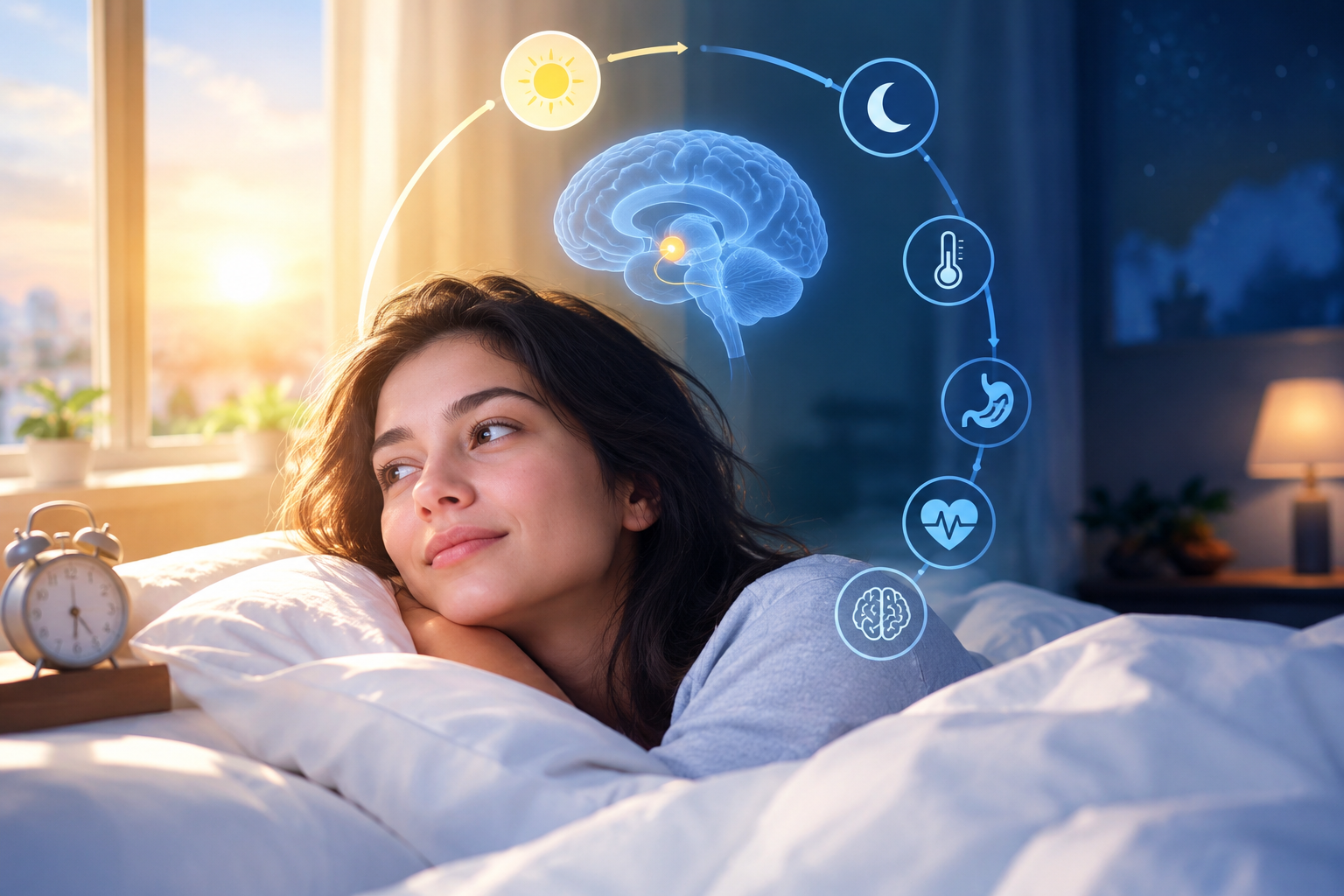
Light -> eyes -> SCN -> your body clocks -> hormones and physiological processes
Let’s explore this step by step
Step 1: Light falls on the eyes
In addition to vision, your eyes have special cells that are sensitive to light. These cells receive light signals from the environment.
Light can be any intensity from bright sunshine to a dim lamp. The cells are then sensitive to the changes in this light and in essence pass on this information to your brain.
Step 2: The information received by the eyes is passed on to the SCN or the master clock
The SCN uses this information to figure out what time of the day it is.
When exposed to bright light, it assumes it is daytime while dark usually means night time.
Step 3: The SCN then relays this information to the various physiological processes in your body
The SCN synchronises the rhythms of the physiological processes in your brain and regulates their timing.
Major physiological processes governed by SCN include regulation of body temperature, hormone production and your sleep cycle.
Step 4: As your SCN goes through different phases of the day, it begins to affect your physiology
Your body goes from being alert to sleepy and everything in between depending on the time of day.
Your hormones are also released at different rates and your body temperature undergoes changes throughout the day as well.
The SCN works with your body to control its physiological processes.
Your body essentially interprets external light signals to figure out what time of day it is and then synchronises your body clock to it.
Why Light is the Most Important Zeitgeber
Scientists call an external cue that makes up a reference for entraining a biological rhythm a zeitgeber. The term essentially means time giver. For humans, one of the most powerful zeitgebers is light.
Sunrise provides us with a cue that it is morning while sunset usually marks the beginning of evening. Unfortunately, in modern society, we can be indoors for most of the day and evening.
And artificial lights can easily fool our brain into thinking it is daytime when in reality it might be getting late.
While your brain might realise it is getting late, it might not necessarily do anything about it. A lot of research into human chronobiology suggests that the impact of light on our body clocks depends on a few factors including intensity, duration, and wavelength of the light as well as the time of exposure.
That is why the information contained in light is biological information.
One of the biological systems in our body that respond to information from light is the hormone called melatonin.
What Does Melatonin Do?
As mentioned earlier, melatonin is sometimes referred to as the “sleep hormone.” However, this is an inaccurate name for several reasons.
For one, it is not melatonin that causes you to fall asleep, but rather the lack thereof. Melatonin plays a critical role in our circadian rhythm.
As it gets dark outside, your body begins producing more melatonin in preparation for sleep. Then, as it begins to get light outside, your body will begin to reduce its output of this hormone. This process is controlled by our circadian system and SCN.
Now we have two systems:
Circadian timing which determines whether it is a good moment to sleep or to be awake.
And sleep pressure which determines how much we sleep.
These two systems can be thought of as two sides of the same coin. Your body clock might be telling you “it is night-time,” while sleep pressure is saying “you have been awake for a long time, you should sleep soon.”
When these two systems combine, that makes it easier to fall asleep.
Why Do We Feel Like Sleeping but Can’t Fall Asleep?
Well, let’s say you are exhausted.
After all, you have been awake for 18 hours, and you really need to get some shut-eye. However, as you lay your head on the pillow around midnight, you find that instead of falling asleep within a few minutes, you are still wide awake.
This happens because your body clock does not always coincide with your sleep pressure.
It is most evident in situations where you are flying around the world, or working rotating shifts or just sleep at the wrong time of the day.
While you might feel very sleepy due to high levels of sleep pressure, your body clock can be confusing you, making you feel more awake than sleepy during times when you should normally be sleeping.
It is important to understand that sleep pressure and your body clock are not the same things. If you ever find yourself feeling tired all day but wide awake when you get to bed, this is one reason why.
Your Body Has Other Biological Clocks Too
While the SCN (part of your hypothalamus) is the master clock for your body, it is not the only timekeeper.
There are other body clocks which can govern other physiological processes in your body and tell different organs to perform specific tasks.
For example, your liver has its own circadian clock that helps to control digestion and metabolism.
The same can be said for your muscles and all other parts of your body. Your master body clock keeps these clocks running smoothly in sync with the day-night cycle so that your body functions properly.
This makes biological time far more interesting than just “your brain decided you were sleepy”.
You whole body is chiming in.
But what if your body is getting conflicting timing signals?
That’s where circadian disruption comes in.
What Happens When Your Body Clock Gets Out of Sync?
Think about jet lag.
You board a long distance flight and your body decides it is time for sleep while the local time says otherwise. Your internal clock needs to be given time to adjust itself to the new timezone. Night-shift working can also result in issues as your social clock might want to tell you to sleep when your circadian rhythm wants you to work. There’s also social jet lag, which is when your body clock and work/social schedule are out of sync. For example, you may have very different sleep patterns on weekdays versus the weekends.
Circadian disruption isn’t just about being tired when you shouldn’t be. There are other issues related to chronotype, lifestyle, shift-work and disease, but the connections between them all aren’t completely understood. The point isn’t to panic about staying up late, but just to realize how important timing is to your body.
Your body doesn’t just care about what you do, but also when you do it.
Can You Reset Your Circadian Rhythm?
Fortunately, when it comes to your biological clock, you aren’t doomed to eternal grumpiness. In fact, your circadian rhythm can be adjusted to different schedules.
Light is generally the most influential factor on your circadian rhythm, so exposure to light during the day and lack thereof at night have a big effect.
Here are a few more tips for adjusting your body clock:
- Maintain a relatively consistent sleep/wake cycle
- Expose yourself to bright light during the day
- Be careful about bright lights at night
This doesn’t mean you have to start living in a cave at sunset. It just means that your brain is sensitive to the lighting environment that you’re in.
Sure, pay attention to meal timing, but don’t be dramatic about it.
Food timing can affect non-brain clocks, says a recent review in Nature Metabolism.
Researchers are beginning to understand how meal timing and metabolic processes are connected, but the relationship between food timing and the body’s circadian clocks is more complex than some online articles would have you believe
A 2024 systematic review of randomized trials found that time-restricted eating had mixed effects on sleep, and that more long-term trials using objective measures are needed.
Stay physically active
Regular physical activity may also provide timing information to the body and be part of healthy approaches to managing sleep-wake schedules.
For people with diagnosed circadian rhythm disorders, treatments can include carefully timed light therapy and, in some situations, melatonin under professional guidance. Timing is key and it is not only a matter of “more light” or “more melatonin”, but rather, these approaches are not quite that simple.
The Bigger Picture: Your Body Doesn’t Read the Clock
So how does your body know when to sleep?
It doesn’t actually know that it is 10:00 p.m.
There isn’t a tiny clock inside your brain whispering:
“Attention everyone, it is now 10:00. Let’s make some sleep.”
There are thousands of biological processes reacting to recurrent signals.
Light hits your eyes. The eyes send information to the brain. The SCN interprets that information and coordinates the body’s central timing system.
Other clocks in the body react. Hormones such as melatonin change. Body temperature changes. Alertness changes. Sleep pressure builds.
And eventually, all these signals converge to make sleep feel increasingly appropriate.
Perhaps the most fascinating thing about it is that the circadian rhythm isn’t really a sleep timer. It is a way for your biology to organise the entire body around something that is predictable: the regular cycle of light and darkness caused by the Earth’s rotation.
Your body doesn’t need a clock on the wall. It has been carrying one inside you all this time.
Frequently Asked Questions About Circadian Rhythm
What is a circadian rhythm?
A circadian rhythm is a biological pattern that has a repeat on an approximately 24-hour cycle. In humans, circadian rhythms can influence sleep, wakefulness, hormones, body temperature, appetite, metabolism and other physiological processes.
What controls the circadian rhythm?
The body’s internal clock is controlled by the suprachiasmatic nucleus (SCN) in the brain. The main external cue that influences the circadian rhythm is entering the eyes, although diet, physical activity level, and social activities also play a role.
How does your body know when to sleep?
The sleep-wake cycle involves both a circadian rhythm and a sleep pressure. The circadian rhythm controls the alertness of the person throughout the day and night, while the latter builds up the longer the person stays awake.
Does screen light ruin your circadian rhythm?
Late evening exposure to bright light disrupts the circadian rhythm and can decrease the amount of melatonin produced by the body. The consequences of such perturbations depend on the intensity, duration, wavelength of the light and the time when it is experienced, so it is not possible to give a blanket answer about all types of screen light affecting circadian systems.
Can you reset your circadian rhythm?
It is possible to adjust one’s chronotype in accordance with changes in their environment, especially when exposing oneself to appropriately timed bright light. Moreover, sleeping and waking up at the same time every day and maintaining other circadian rituals can help reset the circadian rhythm, while people with chronic circadian rhythm disorders should seek professional assistance.