
You’ve slept for eight hours and your brain still hasn’t nudged you that it’s morning. And your alarm clock may be what gets you up every day.
Your body has its own internal clock as well. Your brain has one of its own, and one of the things that keeps it on track is light.
The body‘s internal clock, or the circadian rhythm, controls when you are sleepy and when you are awake, and also controls when other body functions occur. One of the ways that the light can help reset your body clock is during the mornings.
You might wonder that you are surrounded by light throughout the day so how is the morning light any different that it help you would reset your body clock.
How does taking a walk outside during the morning affect the time when you feel sleepy at night? Well, let‘s explore the light.
Introduce Your Master Clock
Inside your brain, there is a collection of cells known as the suprachiasmatic nucleus, or SCN. Don’t be intimidated by the name, we all have one! The purpose of the SCN is that of a master clock.
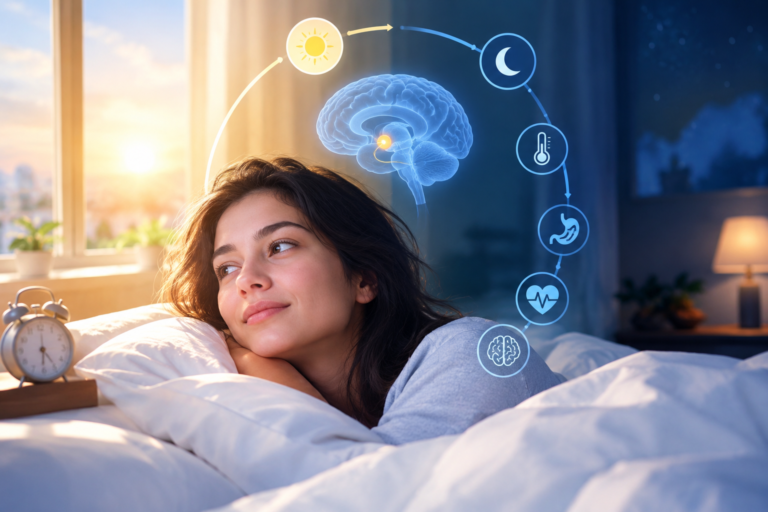
The SCN is located in a part of the brain called the hypothalamus, and controls various processes in the body such as the sleep-wake cycle, hormone production, body temperature, and more. Although the SCN is not the only clock in your body, it does a great job of regulating the different rhythms so that they are more or less in sync with each other, following a 24-hour pattern.
Here’s the interesting thing: your internal clock can continue to tick, even without an alarm clock or a window, but it needs regular hints and clues from the outside world to keep it accurate. To reset your body clock, it is important to synchronize it with environmental stimulus such as daylight.
And the biggest clue in your entire body is your eyes!
Why Morning Light Matters
The eyes, in addition to seeing the world, contain photoreceptors which send information to your brain about the time of day. Light enters through the retina into the brain, tricking your SCN (your brain‘s central clock) into knowing what time of day it is outside.
Morning light is basically telling you:
“Morning mate, the new day has begun!”
which signals your circadian rhythm to help organize your body’s daily activities. The light helps control the time melatonin is released in your body, which is the hormone influences sleep-wake cycle. You have high level of melatonin when you’re feeling sleepy and lower levels when you are awake.
How Light Actually Shifts Your Sleep Schedule
Consider it as a simple chain of cause and effect.
Morning light falling on the eyes resets the clock in the brain.
In particular, light entering the eyes activates specific photoreceptor cells in the retina, which in turn, send regulatory signals to the SCN, which in turn, make modifications to the circadian timing of physiological processes.
As a result, timed exposure to bright light in the morning can advance the circadian clock, perhaps helping earlier sleep and wake times. A review of the relevant literature confirms this, finding that timing of bright light exposure can affect the timing of the sleep period.
But there’s a catch:
One bright morning won‘t necessarily give you a brand new start as if you hit a magic button.
Your biological clock is complex and mysterious – for scientists who study it, it‘s a “black box” that they can‘t open and examine.
How much or how little light you’re exposed to (and when, and for how long) can influence your body’s biological clock. So can other factors, including how much light you’re usually exposed to at other times of the day.
So if your sleep schedule has been slowly shifting later and later, consider morning light exposure as more of a nudge than a reset towards the right direction.
What If You Don’t Experience Morning Light
A fascinating characteristic of modern life.
For most of our species’ existence, daytime was associated with exposure to the varying degrees of light outside. Now it is entirely possible to wake up, sit inside, and not see daylight until the afternoon.
Indoor illumination can be much less intense than daylight.
That being said, exposure to indoor lighting does not guarantee harmful or useless exposure. Simply put, the amount of light you‘re exposed to may not be enough to help your circadian rhythm properly. Researchers have found that both the intensity and timing of light exposure are factors in regulating one’s biological clock.
At the same time, modern schedules can provide an abundance of light when the body expects darkness, especially in the evenings. Thus, the issue is not necessarily a lack of sunlight, but rather, a disruption of the circadian rhythm that is encoded in our biological clocks.
For some individuals, this disruption may cause one’s internal clock to shift or become desynchronized with their normal sleep patterns.
So, Should You Get Some Sunlight Every Morning?
If you want to give your body clock a clear morning signal, seeking light exposure after waking is an easy habit to adopt.
You don’t have to turn it into a mystic wellness practice, but there are a few guidelines to keep in mind. Try to get outside after waking, if possible, since daylight is significantly brighter than the average indoor illumination.
Maintain a roughly consistent wake-and-sleep schedule, as your body’s circadian machinery responds most favorably to routine. Allow your eyes to adapt freely to the outdoor light; there‘s no need (or value) in staring directly at the sun.
You should also remember that not every hour of the day is synonymous with healthful insomniac intervention.
And remember that if you have a serious or long-term sleep-schedule problem—such as chronic inability to fall asleep until 3 a.m.–a casual stroll might not do the trick. Light therapy as a clinical tool makes use of precisely timed and dosed exposures, so it’s a good idea to consult with your doctor about chronic sleep issues.
Your Morning Starts Before You Feel Awake
The thing about the body clock is that is doesn’t start when you feel awake.
The moment you wake up, your brain is already processing information about what your day ahead will contain. One of the things that it is looking at is the amount of light coming into your eyes.
The next time you have a day where it feels like your body clock is several time zones behind, you might want to put more thought into the light that you are seeing rather than the alarm on your phone
While your alarm may be going off at a certain time, your body clock is actually being set by the time of year and the things that you see around you.
FAQ
How long should I be getting morning sunlight?
There is no universal number as it can vary depending on a variety of factors. The circadian effect can vary based on intensity, timing, duration, and your personal circumstances. Outdoor light on a cloudless day may provide much more light than what you are used to indoors. A good start may be to get outside after waking up.
Can morning light be used to reset one’s circadian rhythm?
It can be advanced when appropriately timed and consistently delivered, but individual schedules need to be taken into account because it is not a quick fix for people with circadian sleep disorders, who require a more tailored approach to their treatment.
Is circadian rhythm disrupted by indoor lighting?
Short answer is yes and no. Circadian rhythms is influenced by multiple factors including intensity, timing and other factors. Artificial light is usually less intense than sunlight but bright indoor light can disrupt natural circadian rhythm and melatonin production.