
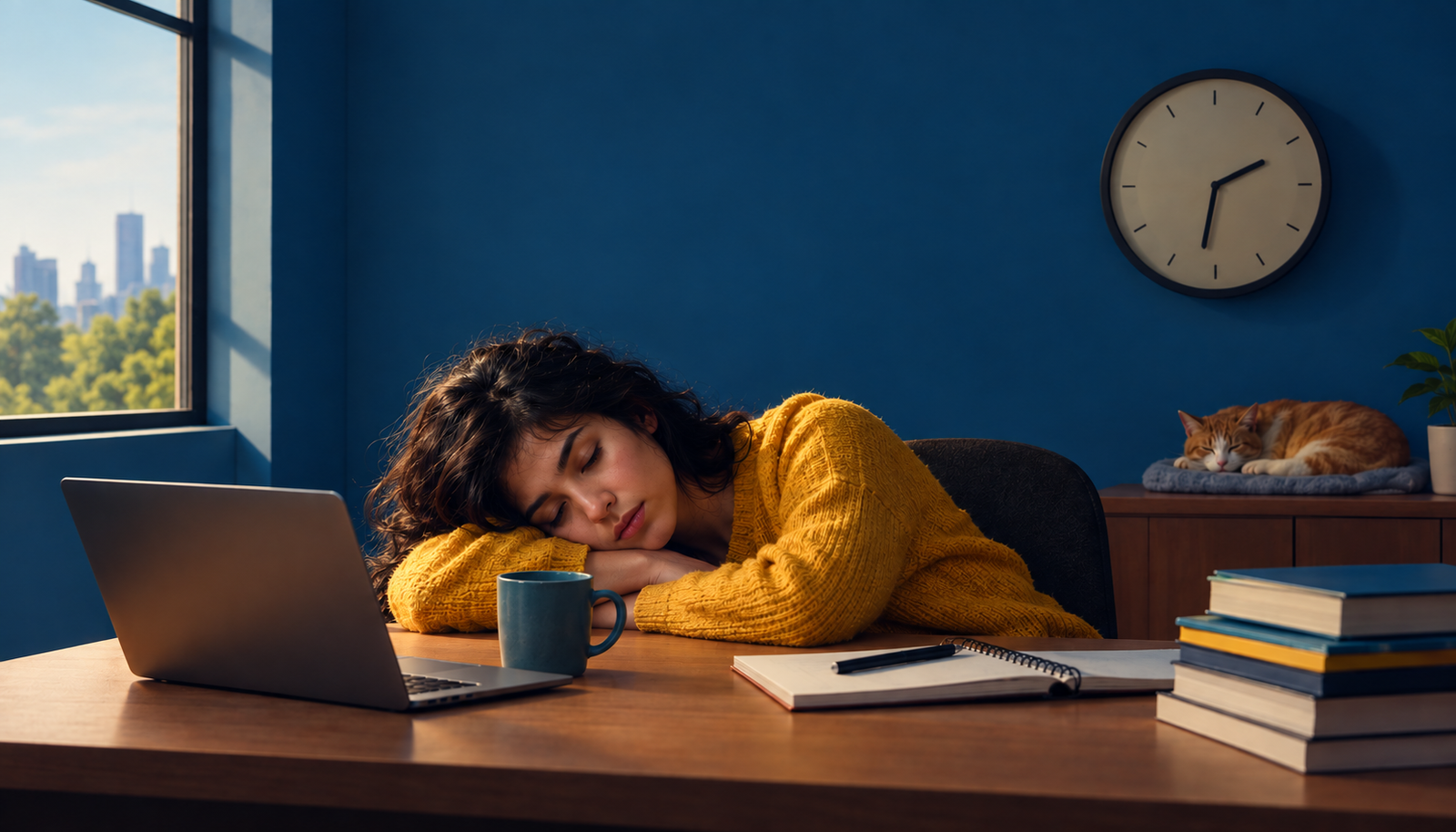

You slept for 8 hours.
You woke up feeling great, had some breakfast, responded to your emails, worked, studied, or whatever else your morning routine consisted of.
And then, as the clock struck around 2 or 3 PM, you find yourself growing increasingly sleepy.
Your focus begins to drift. You’re attention is diverted from the spreadsheet you’ve been working on to something relaxing- a comfy, squishy, pillow.
You think: ‘ Why do I feel sleepy in the afternoon? I slept 8 hours last night’.
That afternoon sleepiness is not always a signifier of a bad night‘s rest. Your brain doesn’t maintain the same wakefulness throughout the day as it did when you first opened your eyes that morning. Two forces contribute to your sleepiness: the amount of hours you’ve been awake and your body‘s natural circadian rhythms, which indicate what you should be doing at that hour. These two forces combine to create the perfect conditions for a nap in the afternoon.
Your body isn’t designed to stay equally alert all day
Your body is not built to be awake constantly for 24 hours.
We often think of alertness as a battery, waking up at 100% and slowly going down to 10% by the time we go to bed. But your brain is not made like that. Alertness fluctuates throughout the day, reaching highs and lows.
Your body temperature, levels of hormones, focus, drowsiness, and numerous other aspects of your body rise and fall throughout the day, controlled by your circadian rhythms, an internal clock that dictates when it‘s time to be active and when it‘s time to sleep.
This is why you might often feel the most energetic at 10 AM, sluggish and tired at 2 PM, only to experience a second wind in the late afternoon.
Scientists have demonstrated that our ability to perform tasks and our overall level of awareness can also follow a circadian rhythm, even when the researchers have controlled the hours of sleep the study participants got each night. So if you find yourself regularly battling your eyelids at 2 p.m., and the question ‘why do I feel sleepy in the afternoon?‘ runs through your mind almost everyday, it doesn’t necessarily mean something is wrong.
You may just have one of those normal dips in your natural sleep-wake cycle.
Meet your two sleep regulators
Here’s the simplest way to think about it.
Imagine that your sleepiness is being controlled by two people on either end of a rope.
One represents sleep pressure. The other is your circadian clock.
1. Sleep pressure: “You’ve been awake for a while.“
The longer you‘ve been awake, the stronger your biological drive to sleep.
Think of it as pressure that builds up in the body during wakefulness. The drive to sleep decreases as we sleep and increases as we wake up, like an hourglass that empties when you sleep and fills again when you’re awake.
This is sometimes called the homeostatic sleep drive or Process S. So even if you’ve had a good night’s sleep, by the time it’s 3 p.m., you’ve been awake for a few hours and accumulated more sleep pressure than you had when you first woke up.
That’s normal.
2. Your body clock: “This is what time it is.“
Your circadian system is your body’s internal clock that coordinates your biological processes with approximately 24-hour intervals associated with day-night cycles. It not only tells you when to sleep at night and when to be awake during the day but also creates a far more complicated set of biological rhythms that make your body more susceptible to sleeping or being alert at particular time of the days. This is the second process researchers use to understand sleep patterns.
Many researchers have used a two-process model to understand sleep and wake cycles in which homeostatic sleep pressure interacts with circadian time-keeping to influence when and how easily we can sleep. This is one of the most influential ways of thinking about why we feel sleepy at different times of the day and why our sleep patterns change as we age.
Let me try to break down what this means in a more straight forward way:
Sleepiness = sleep pressure plus the influence of your biological clock
So not exactly a literal equation, but something like this could be helpful for you to keep in mind. In a way your brain is calculating the time you should sleep based on the time of the day and how long has it been since you’ve woken up. Therefore the time of day also plays a role in how sleepy or rested you feel. Your brain is basically answering these two questions:
“How long has it been since my last nap?“
and
“What time does my body think it is?“
As you can probably tell, the answer to both of these questions influence your sleepiness.
So why do we feel sleepier in the afternoon?
Well, at some point during the day many of us feel the most sleepy. This is sometimes called the post-lunch dip or the afternoon dip, although I think this term is misleading since you don’t actually have to eat lunch to experience it.
Researchers have found that the dip can even occur when people haven’t eaten a lunch meal, so it’s not just that you literally ate a nap. It seems like the dip has a large circadian component, which means it’s related to our body’s natural rhythms.
This explains the feeling of, “I slept for eight hours. I haven’t done anything physically exhausting. Why do I suddenly feel the need for a nap?“
This occurs because eight hours of sleep may not completely deplete your sleepiness, and your circadian rhythm is still likely to bring about a period of lower wakefulness at a certain point of the day. This is why sometimes, even if you had a good night‘s sleep, you can sometimes have a sudden wave of sleepiness in the afternoon.
Is it the lunch that has made you so sleepy?
Lunch may have contributed to your sudden sleepiness, but probably not for the reason you think.
We’ve all been there before. You ate lunch, and you were instantly hit with this wave of sleepiness that made you wonder if taking a nap under your desk would be considered appropriate workplace behavior. It’s tempting to blame it on your lunch, and there might be some truth to that. The size of the meal and your own personal digestion process can definitely affect how you feel post-meal, but saying that your afternoon slump is caused by lunch is an overstatement.
Studies have shown that the post-lunch crash is a thing that can happen even without a meal, and is tightly related to the time of day. In one such study relating to afternoon sleepiness in drivers, the article refers to it as a, “bi-circadian,” problem, and a, “sleepiness during driving episode.” The study also stated that the afternoon slump was mostly unrelated to the meal.
So the next time somebody lays the blame squarely on the spaghetti bolognese, you can point them to the clock. It could be the biology.
Why do some people experience it more?
Your circadian rhythm is only part of the answer.
You may not be sleeping enough for your own good. Eight hours is a good average, but everyone has different needs and a regular sleep schedule helps too.
Or perhaps you didn’t have eight hours of consecutive and restorative sleep. If your sleep is broken up, out of sync with your biological clock or otherwise compromised in quality, you might feel exhausted even if you think you‘ve gotten enough sleep.
You may have an irregular sleep schedule. Waking up at different times during the day and night confuses your body clock, making napping during daylight hours harder. Your circadian rhythm keeps you awake when it‘s dark and asleep when it’s light, so it helps to keep it in sync with a regular sleep schedule.
You’re probably just doing something boring. There‘s a big difference between being mildly sleep deprived and bored out of your mind. A silent room, cold day, repetitive work and long meetings can turn an ordinary boredom into a nap-inducing torpor. Your body doesn’t need nearly that much sleep to feel tired and unfocused during a 3 p.m. lecture.
Perhaps your body clock just doesn’t agree with your work schedule Some people are naturally more alert later in the day while others are night owls. If your circadian rhythm doesn’t agree with your working hours, you’ll be more likely to feel sleepy during the day. People who work rotating shifts or suffer from jet lag or other circadian rhythm problems experience a similar dissonance, only to a greater extent.
Sometimes there’s an underlying sleep issue. Excessive daytime sleepiness can be caused by sleep disorders or other medical/lifestyle factors.
This is why it’s important to differentiate between normal drowsiness and excessive sleepiness.
While dozing off around 2:30 PM is normal, experiencing repeated episodes of extreme tiredness while trying to engage in everyday tasks is not. If you find yourself dozing off unintentionally or suffering from debilitating fatigue on a regular basis, it might be worth speaking with a medical professional.
If you want to learn more about the potential causes of unexpected sleepiness, even if you get a “normal” amount of sleep per night, be sure to check out our article “Why Am I Still Sleepy After 8 Hours of Sleep? 9 Possible Reasons”
Can you combat the afternoon slump?
Short answer: Yes, but you should think of it more as “working with your body’s circadian rhythms” than “hacks to feel more energetic.”
Get some light exposure
Light is one of the strongest influencers of your circadian rhythms, which are responsible for regulating your sleep-wake cycle.
While exposure to natural daylight has been shown to help regulate your body’s internal clock, it can also provide an acute boost to your energy levels, depending on the timing and intensity of the exposure, as well as your sleep pressure state. Several studies/reviews have shown evidence of light’s ability to acutely increase human alertness.
So if possible, take a break outside during the day, instead of sitting inside under artificial light all day. A walk outside can offer two things that will help you: light and movement.
Move around
You do not need to exercise vigorously, but getting up and moving can help counteract the effects of sitting for extended periods of time. It can even help if your afternoon slump is making you extra sleepy.
Keep a reasonably consistent sleep schedule
Your body’s circadian clock is regulated in part by your environment and daily schedule. Keeping a reasonably consistent sleep and wake time can help keep your circadian clock properly synchronized with the world around you.
And remember to get enough sleep in the first place! A circadian rhythm can’t make up for chronically insufficient sleep.
Be conscious of your caffeine intake
Caffeine can help you feel more awake.
But it is not a substitute for sleep and the effects of caffeine can linger long after you‘ve finished your cup. In a controlled experiment, subjects who ingested caffeine 6 hours before bedtime had significantly worse sleep quality than those who’d ingested a placebo.
So using progressively increasing amounts of caffeine every afternoon may solve today’s sleepiness while secretly creating tomorrow’s.
Consider a short nap
For some people, a brief afternoon nap can be useful. Napping can help cut down on sleepiness and increase alertness (though the optimal amount of time for a short nap isn’t clear), but it may also lead to a groggy awakening, called sleep inertia, which can last for a few minutes to an hour.
The point is that a nap should be utilized as a tool, rather than a cure all for chronic sleepiness. If you‘re finding yourself in need of long naps on a daily basis to function, it’s worth investigating why you’re sleep deprived in the first place.
The surprising truth
The afternoon slump isn’t proof that your body is failing you, in fact, it’s doing exactly what it’s supposed to do.
Your brain is constantly negotiating between your need for sleep and your circadian rhythm, and as a result, your ability to stay awake throughout the day is anything but constant
For some people, at some point in the early to mid afternoon, things become a little lopsided in favor of sleepy time. That doesn’t mean that you need eight more hours of sleep, it simply means that your alertness doesn’t follow a straight line throughout the day. If you’ve had eight hours of solid sleep and two hours into the day you can’t seem to shake a sleep induced haze, it’s nothing to worry about.
In short, the next time your brain decides to send you to dreamland at the height of the afternoon, don’t be so quick to blame your poor sleeps. Your body could be telling you something. Sometimes, it‘s not about how much sleep you get, it‘s about when.
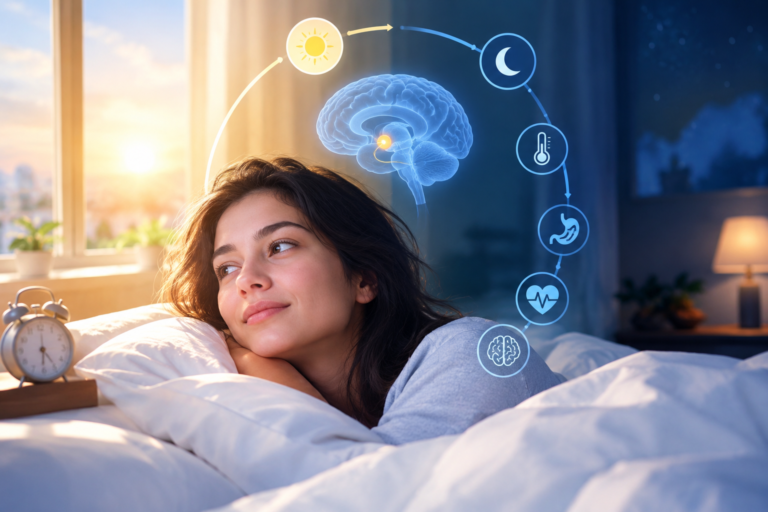

[…] reason for this is because sleep is controlled by two different processes: “sleep pressure”, which accumulates as you stay awake for longer periods of time, and […]
[…] are a variety of factors which could contribute to why you feel so tired during the afternoon hours, even if you had what […]