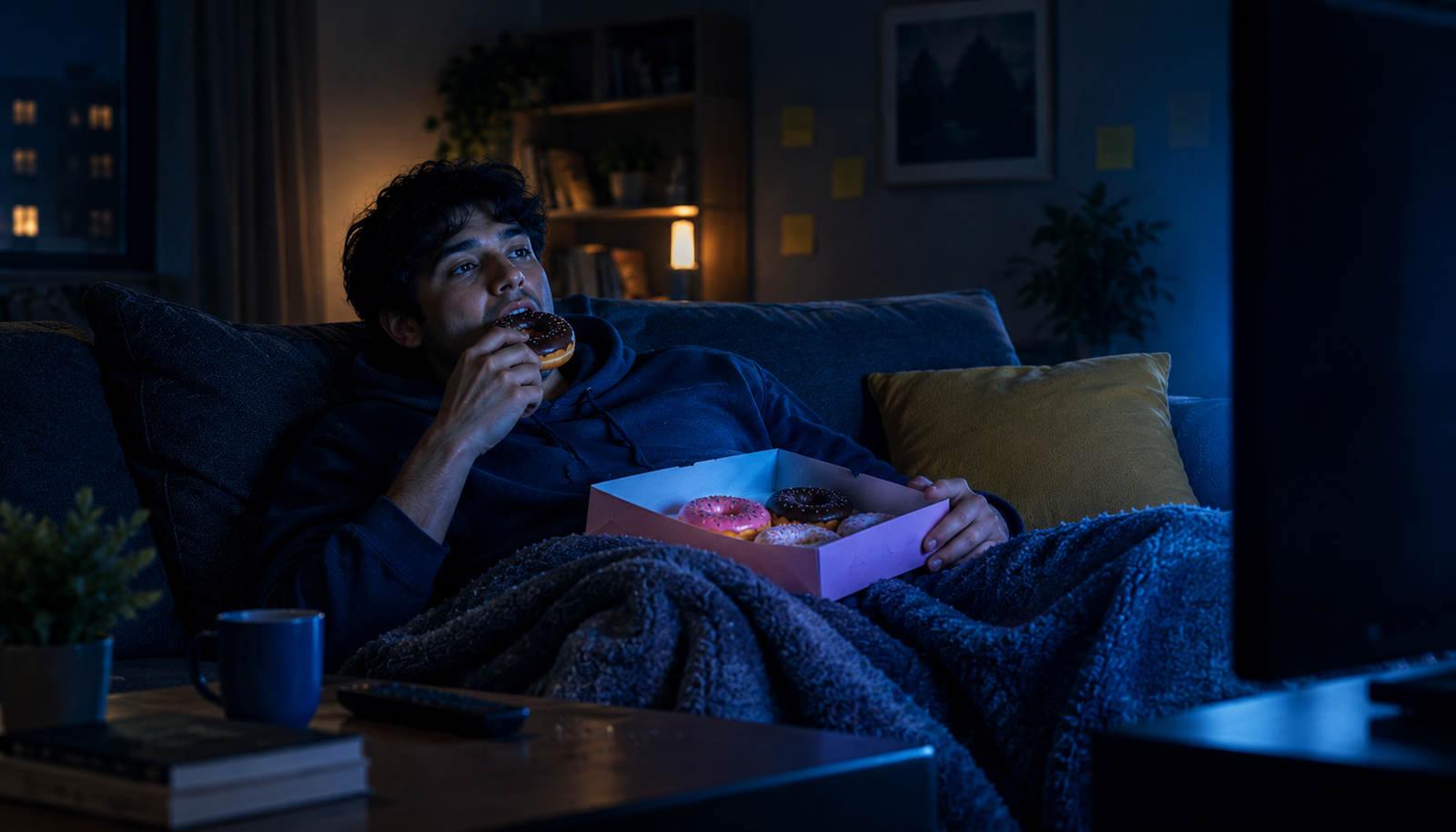

It‘s 11:47 p.m.
You should have been asleep an hour ago. Instead, you are on the couch scrolling through your phone, and suddenly you realize something:
You need something sweet.
Not an apple or a serving of nuts, not the vegetables sitting quietly in your fridge.
You want cookies
or chips or the ice cream you forgot in the freezer
or that enormous slice of leftover pizza that somehow looks like the best meal you ever ate.
You tell yourself, I‘m not actually hungry, I‘m just tired, but somehow you end up eating it anyway and in the morning you wonder why do I crave junk food at night.
It‘s not that you have less willpower after a bad night of sleep, although scientists have been studying the relationship between sleep loss and hunger for years.
Things get a little complicated. Sleep deprivation has a strange way of altering your brain chemistry in such a way that it increases food-seeking behavior, encourages out-of-schedule snacking, and makes otherwise unhealthy foods seem like the most delicious thing in the world.
So here‘s a look at what exactly happens inside your haphazardly fed brain on less sleep.
Why Did You Suddenly Want Junk Food?
Let‘s say you have two versions of yourself. One version got a good night of sleep, and the other version went to bed at 2:30 a.m. after watching an episode of their favorite TV series and woke up groggy the next morning. Let’s say that at 10 p.m., both versions of you see a cookie jar.
The version of you who got a good night of sleep might think, “Ah, cookies. I‘ll have some after dinner tonight.“
Meanwhile, the sleep-deprived version of you would look at the cookie jar like it was the most beautiful thing they‘d ever seen.
This actually happened in a lab, in a study published in American Journal of Clinical Nutrition, restricted sleep had a strange way of increasing food intake, especially among participants who were given a larger window of time to eat late–night snacks. The participants given less sleep consistently ate more calories overall, with a higher percentage coming from unhealthy snacks.
Another controlled study showed that after nights of extreme sleep restriction, the participants were consuming more calories during the late-night period. Most of these calories were due to additional eating events, rather than just increasing the size of meals that they were already having.
So, there is something about being awake (and tired) at late hours that changes your eating behavior
But why?
To understand it, you need to stop thinking about your hunger as a simple physiological drive. Your brain does not only ask itself, “Do I need calories?” but also asks “How rewarding would it be to eat this?”.
And the sleep loss seems to influence that second question.
Your Sleep-Deprived Brain Has a Different Relationship With Food
Your brain has multiple systems controlling the eating process.
One area cares about your homeostatic needs: it regulates hunger and satiety, and makes sure that you eat as much as you need to maintain your body weight.
The other system gives value to food: it tells you that chocolate cake is awesome, that french fries are delicious and that that last piece of pizza is not going to hurt anyone, really, you should eat it.
This system uses several interconnected brain regions, including those that control motivation, emotions and decision-making. And sleep deprivation changes things.
One of the interesting studies published in Nature Communications used brain scans to see what happens in the head of sleep-deprived people. Researchers deprived participants of sleep and then analyzed their brain activity while they ate. They found decreased activity in several frontal cortex and insula regions responsible for evaluating food desirability, alongside increased activity in the amygdala, a brain region associated with emotional and motivational responses to food. The researchers concluded that sleep deprivation caused a change in the brain’s evaluation of food desirability.
In other words, sleep deprivation not only made the participants hungrier. But it also caused changes in the way their brains were processing the desirability of food. This is an important difference, because as the authors note, eating is not a simple matter of turning on a single hunger–seeking circuit in the brain. It’s more like a negotiation between several circuits.
One asks “Is my body deficit in energy?“
Another asks “How much do I want that food?“
Another asks “Should I be eating this right now?“
And yet another tries to maintain homeostasis and control the others.
These can be influenced by sleep loss.
Sleep Loss Can Make Food More Tempting
Researchers don’t have to rely on self-reported measures of desire for food. They can actually look inside the heads of people who have been sleep restricted, and see what seeing food does to them.
In the article, the authors of the study in question (published in the American Journal of Clinical Nutrition) put healthy adults in a brain scanner after both restricted and habitual sleep, showing them images of various foods while measuring their responses.
They found that, after restricted sleep, viewing food images activated several “reward” areas of the brain, namely the putamen and the nucleus accumbens. Think about it this way:
Imagine looking at an image of a doughnut when you’re feeling particularly well–rested.
Your inner monologue may go something like:
“Doughnut. Nice.“
Now, picture the same exact doughnut after multiple nights of terrible sleep.
The inner monologue now may sound a bit more like this:
“Doughnut. Seems like a good idea.“
Obviously, this is a massively oversimplified look at how the brain works, but it’s enough to explain the point. Food can begin to seem more attractive and rewarding after a bad night (or two or three) of sleep. This is one reason sleep researchers aren‘t all that keen on the entire “laziness” narrative.
Having your brain’s reward system not “reward” you as readily can make the decision to eat well seem like a far simpler choice to make, but that’s not the case. It’s less of a “good choice versus bad choice” scenario and more of a “the good choice is easy, but the tempting, delicious alternative has just gotten a lot more tempting.“
It’s Not Just Hunger
Here we arrive at the popular theory, the most common explanation for the relationship between sleep and eating.
You’ve probably heard it already: that when you don’t get nearly as much sleep as you should, your ghrelin (hormone that makes you feel hungry) goes up and your leptin (hormone that makes you feel full) goes down, making you feel hungrier than usual.
It’s a fairly appealing theory, is what I’m saying. It’s not entirely accurate, though.
Ghrelin and leptin certainly play a role in determining when and for how long you’ll feel hungry, but experimental research into the connection between sleep and ghrelin and leptin hasn’t shown nearly as consistent and straightforward of a link between sleep loss and increased ghrelin and decreased leptin.
A large-scale study looking at randomized controlled trials, for instance, found that while sleep restriction did increase subjective feelings of hunger and calorie consumption, there was no obvious link between restricted sleep and decreased average levels of leptin or increased average levels of ghrelin. So if sleep deprivation makes you want cookies, we can‘t just think,
“My ghrelin is high. My leptin is low. Therefore, cookie.“
The biology is much more complex.
Scientists are beginning to think of appetite as a multi–faceted process.
There’s homeostatic appetitive drive – your body’s natural urge to experience pleasure as “sweetness” of food, and how motivated you are to acquire and consume food.
Sleep deprivation can impact all of these drives which may explain why you aren‘t thinking about steamed veggies when you‘re tired, but rather something with more calories and flavor.
Why Do Donuts Look Better Than Broccoli After a Bad Night’s Sleep?
Let’s do a little informal experiment.
Place a plate of steamed broccoli and a warm, glazed doughnut in front of a well-rested friend. Now do the same experiment, but this time, your test subject has gotten only four hours of sleep. I’m willing to bet the doughnut has suddenly transformed into a more desirable snack.
It‘s not that your brain has decided vegetables are bad, but rather that when you’re sleep-deprived, your brain craves an immediate reward.
A doughnut is a great example of quick gratification. It has carbs for energy, fats, and loads of sugar that makes it impossible to resist. Broccoli, however, does not shout, “I will make this terrible day better.” The real issue is that sleep deprivation may lead to increased activity in the brain’s “reward” circuits when it comes to food. In the Columbia study mentioned earlier, restricted sleep led to increased activation in multiple brain regions associated with food and reward.
Another study found that lack of sleep altered activity in the frontal regions responsible for evaluating food and caused an increase in the amygdala activity. Together, these results suggest that sleep loss can alter the value of food to your brain. And this is good news for junk food, as this kind of food is now more available than ever.
The problem is not only that your sleepy brain thinks that pizza is delicious. Pizza can be delivered within 20 minutes. The cookies are in the kitchen. A fast food is open at midnight.
Your sleepy brain does not have to fight much to satisfy its cravings. It is the combination of biology and the environment.
Can One Bad Night Make You Gain Weight?
Before jumping into any conclusions, let‘s put the brakes on the dramatic headlines.
You won’t gain weight overnight from one night of sleep loss. And you won’t put on extra 2 kilograms just because you had a sleepless night and then you also had a pack of cookies. Body weight is generally affected by multiple factors and changes are apparent gradually.
In controlled experiments, researchers have seen increases in food intake during the experimental sleep restriction. Study revealed healthy adults, five days of restricted sleep were related to greater weight gain than the control condition and greater caloric intake, especially during the additional hours the participants were awake at night.
Another experimental study found that five days of insufficient sleep increased energy expenditure slightly, but participants increased their food intake significantly (especially after dinner) and gained weight despite the increase in energy expenditure.
A meta-analysis of 41 randomized controlled trials concluded similarly but with less emphasis on the changes in energy expenditure: sleep restriction was associated with increased hunger and increased energy intake and modest weight gain and reduced insulin sensitivity; however, the studies were highly variable, and the researchers found little evidence that sleep restriction consistently caused changes in energy expenditure or in the appetite hormones leptin and ghrelin.
So the scientifically responsible conclusion isn’t:
“Sleep less and you’ll become overweight.“
but rather repeated instances of insufficient sleep could affect eating behavior and metabolism in ways that might contribute to increased risk of weight gain
Much less dramatic, but much closer to the truth.
The Sleep–Food–Weight Cycle
Let’s break it down to grasp it better.
Think about sleep as one link in a chain of related processes.
Poor sleep
↓
Food becomes more rewarding and eating behavior may change
↓
You may eat more calories, specifically energy-dense snacks
↓
You may begin to eat more calories than you expend, which can lead to weight gain
↓
Metabolic changes and other effects associated with excess weight can interfere with sleep
↓
Poor sleep
And the cycle begins again.
Of course, real life is much more complicated than that. Sleep is affected by stress, work schedules, mental health, medications, environment, illness, caffeine, alcohol, physical activity, and dozens of other factors. Weight is also influenced by genetics, diet, activity, socioeconomic factors, medications, hormones, and many other biological and environmental variables. So while sleep is not a magic master switch that explains obesity, it could be part of the puzzle.
And importantly, this relationship doesn’t have to go in one direction: short sleep may make it harder to eat healthy, but having obesity or metabolic problems could also be associated with poorer sleep.
This is why many scientists now view sleep, eating behavior, metabolism and body weight as interconnected systems.
So, Should You Sleep More to Lose Weight?
This is where the research becomes particularly encouraging.
If you know you’re chronically sleeping too little, getting more sleep could improve your eating behavior. One of the most compelling studies is a randomized clinical trial published in JAMA Internal Medicine that followed adults with overweight who chronically slept less than 6.5 hours per night. Study participants were divided in two groups: those who participated in a sleep extension intervention and those who didn’t. On average, participants in the sleep extension intervention group increased their sleep duration by approximately 1.2 hours per night. And they consumed approximately 270 fewer calories per day than the control group after two weeks of intervention and lost a small amount of weight.
Take note of what the researchers did NOT do. They did not dictate a strict diet. They did not prescribe a strenuous exercise regime. They simply tried to help people sleep longer.
Does not mean that sleeping longer is a magical weight-loss elixir, as the study was relatively small, short-term, and focused on a very specific group of adults with overweight who happened to be chronically sleeping too little. We can not extrapolate this information to suggest that it will have the same effect on everyone, or that it will perpetually have this effect. But, this study does have some interesting implications in that improving sleep quality could have beneficial implications on the regulation of food intake, which is a far cry from suggesting that sleep is somehow a magic weight loss elixir.
It is important to focus on sleep as a component of a far more complex system. If you are chronically lacking in sleep, it may be beneficial to focus on improving your sleep as a part of focusing on improving your overall health as a whole, rather than thinking of it as a magic bullet point for weight loss.
The Takeaway
So, why does a bad night’s sleep make the cookie jar so enticing?
Not only are you fighting a fatigued body, but you’re also battling with a temporarily-effected brain.
Lack of sleep has implications on the way that your brain responds to hunger cues, particularly in certain brain regions responsible for processing food. It can disrupt your desire to eat, cause you to eat more at night, and can even prioritize the most sinfully-delicious foods. And now, researchers are starting to understand that this may not just be a simple case of “your body is telling you to eat”.
The brain is a complex and powerful organ, and sacrificing a night of good sleep may not just impair your judgement – it may make you more susceptible to seeking out particularly rewarding stimuli, such as foods rich in fat and sugar, in a search for greater stimulation than usual.
Your healthy habits were not defeated by your lack of sleep. They were simply swum off the tracks by an impaired brain – one which has a much harder time ignoring the delicious, rewarding stimulus of a doughnut at the break room.
This has important implications, not just on our relationship with food, but on our understanding of sleep loss as a phenomenon in itself. Instead of asking yourself, “why can‘t i be as disciplined as other people when it comes to my diet and exercise?“, you should instead be asking “why is my brain overriding my healthier tendencies when i haven‘t slept well?”.
And, as research is leaning towards, that question has a far more complex answer than “because your body is low in x”.
Perhaps, when you are tired, your brain isn’t searching for fuel. It’s searching for a distraction. And, when the usual feeling of satisfaction after a meal is dulled, the brain will happily chase another source of reward. Your midnight snack, perhaps.
So, next time you find yourself staring, bleary-eyed and dissatisfied, into your kitchen cabinet at 12 AM, consider this – your good habits weren‘t crushed under the weight of a poor night’s sleep, but rather hijacked, rewired, and manipulated by an exhausted, unsatisfied brain.