
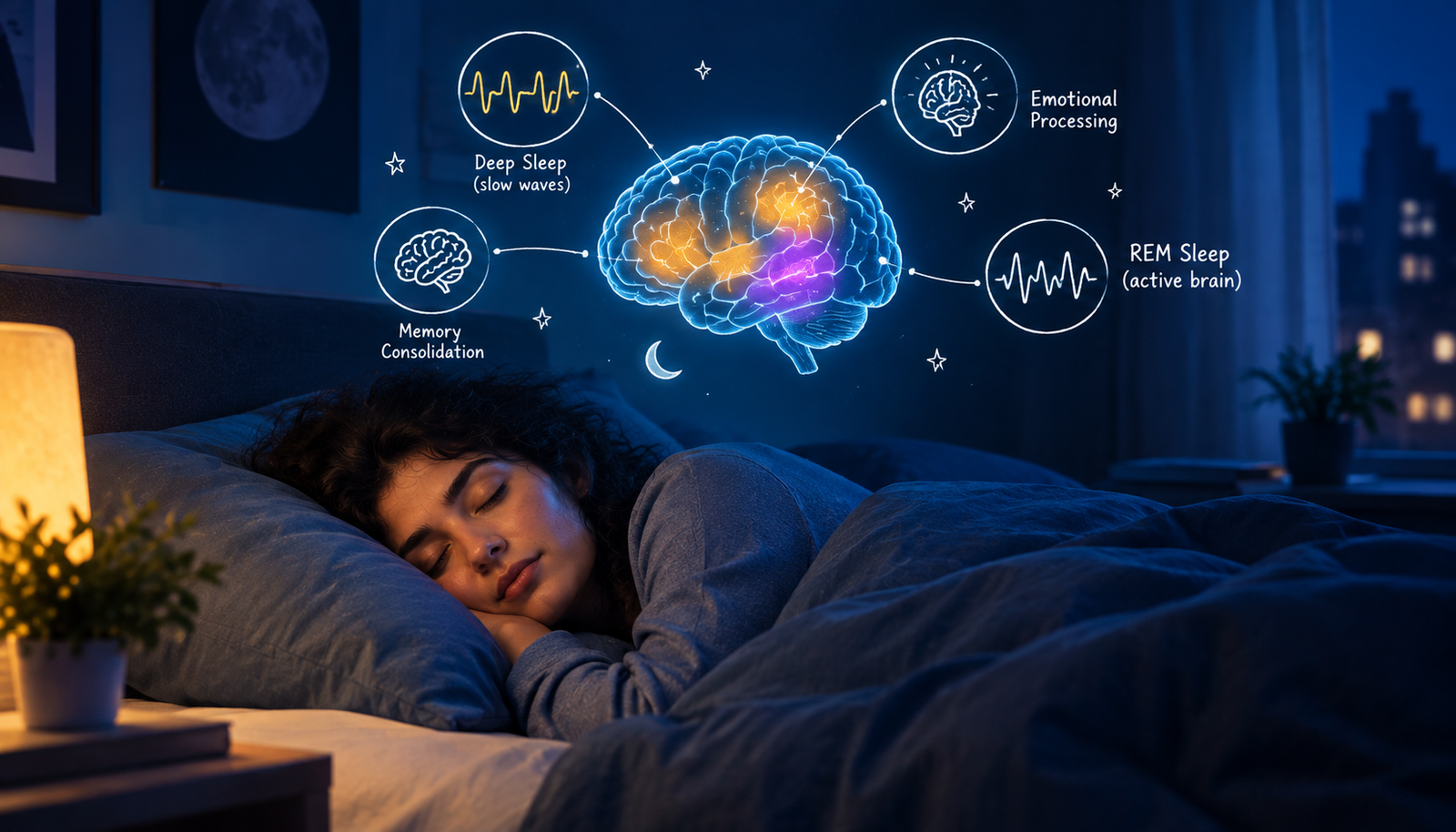

The lights are turned off, your eyelids close, you stop responding to the world around you and, from an observer’s point of view, it may seem as if the activity in your brain is simply switched off.
But this is not the case.
Although the organization of this activity changes, your brain remains highly active throughout the duration of your sleep. The specific patterns of activity, communication between different brain networks, and the responsiveness to the outside world are changed, however.
Activity in the brain during certain stages of sleep can be dominated by large-scale slow oscillations, whereas during other stages it can resemble awake brains. The amount of blood flow and activity varies between different regions in the brain, as well as between different stages of sleep. For example, the results of a 2024 systematic review and meta-analysis of human studies found that cerebral blood flow was generally lower during NREM sleep and higher again during episodes of REM sleep, which reflects differences in demands on the brain during these phases.
Sleep is not a state of inactivity of the brain.
It results from a change in the operating mode of the brain.
By perceiving sleep in this way, we can understand why sleep occurs, and address familiar puzzling questions about it: Why do we become so difficult to awaken during sleep? How can an alarm clock penetrate into an apparently deep sleep and call us to consciousness? Why can the sleeping brain create such fascinating dramatic tableaux in dreams, while the body is totally paralyzed? What is the brain up to while it is asleep?
Let us look more closely to understand brain activity during sleep.
What Happens to the Brain When You Fall Asleep?
Falling asleep is not something that happens suddenly, like when a light switch is flicked. Usually, there is a progressive giving way of wakefulness into sleep (it may also be almost instantaneous, for some people).
Once you start to fall asleep, your brainwaves begin to slow, transitioning from the patterns of wakefulness into those characteristic of early NREM sleep. You also become less responsive to your surroundings.
Something that you could not stop thinking about ten minutes ago may feel utterly unimportant in this new, hazy state. As you begin to drift off to sleep, you may even think, or dream, that you have been asleep the whole time, when in fact you have likely been lying awake for several minutes. It is a strange sensation.
There are two forces at work here.
The first is often called sleep pressure. Basically, the longer you stay awake, the more pressure builds up in your brain to make you sleepy.
The second is your circadian clock. It probably doesn’t surprise you to learn that these two factors work in tandem (they do); you might also guess that your brain uses them to dictate when you should feel sleepy (it does).
Scientists say that they have two independent processes that control sleep and wakefulness: one regulates how long you have been awake, and the other keeps track of the time of day. Think of it as a seesaw between your desire to sleep versus your desire to stay awake. Your circadian clock is asking itself, “Is this a good time to sleep?,” while your sleep pressure is saying, “How long has it been since I last slept?”
When both are in agreement, it can be significantly harder to stay awake. Your brainwaves progressively slow down, and you begin to enter deeper stages of organized sleep, as opposed to simply being awake.
Brain Activity During the Different Stages of Sleep
Sleep is clearly not a singular process. Brain activity during sleep goes through different stages of NREM (non-rapid eye movement) sleep (N1, N2, N3) and REM (rapid eye movement) sleep.
Modern science classifies these stages mainly based on brain activity measured via EEG as well as eye movements and muscular activity.
Current sleep scoring categorizes NREM into three stages—N1, N2 and N3—followed by a period of REM sleep.
N1: The Transition From Wakefulness to Sleep
N1 represents the lightest type of sleep. It is the point between waking and sleeping. Your muscles relax, your eyes can move, and the electrical activity of the brain slows down in frequency.
This stage is typically very brief. Moreover, it is the stage where one may experience the most confusing phenomenon regarding sleep: “I wasn’t asleep.”
Waking during N1 can cause one to believe that they had just been “resting/considering things”, when, in reality, the brain is clearly starting to transition into a sleep state.
N1 is also a stage when one may experience strange and disconnected thoughts or dream-like images. You might imagine sounds, fleeting images appear in your mind, or you find yourself suddenly floating.
Essentially, your brain is transitioning from one state to another.
N2: When the Brain Becomes More Disconnected From the Outside World
N2 follows N1, and constitutes the largest portion of typical adult sleep.
Two features characterize N2: sleep spindles and K-complexes.
Spindles are short bursts of activity that occur at a faster frequency, while K-complexes are large waves that may occur in reaction to internal or sensory events.
You can think of these features as parts of the brain’s intrinsic sleep management system.
The brain is beginning to disconnect from the outside world, but not completely. Sensory events are being filtered by the brain.
This is important.
There is growing evidence that sleep consists of decreased and selective processing of information, rather than blanket sensory shutdown. A 2024 review described this as “a balance between protecting sleep from arousing stimuli and allowing enough sensory processing to detect potentially important events.”
N2 is also critical for memory processing. Modern research suggests that sleep spindles, slow oscillations and hippocampal activity work together in coordinating the reactivation and reorganization of memories. A 2024 review described the interaction of slow oscillations, spindles and hippocampal “ripples” as an important mechanism through which newly learned information can be processed during sleep.
Thus, while N2 may seem like the brain is becoming increasingly quiet, it is really undergoing a highly structured stage of sleep.
N3: The Brain Enters Deep Sleep
N3 is the stage that people usually refer to as deep or slow-wave sleep.
Here, the brain activity consists largely of large slow oscillations. The brain becomes far more synchronized compared to when one is awake, resulting in characteristic slow waves typical of this stage on a standard EEG.
This stage is also characterized by a person generally being very hard to wake up from.
A person woken from deep N3 sleep can feel somewhat disoriented for some time, as their brain goes through an adjustment phase before transitioning into the normal waking state.
Deep sleep should not be mistaken for a brain that is inactive.
In fact, quite the opposite: the brain activity is highly structured.
Whereas most brain networks rapidly exchange information during wakefulness, large populations of neurons enter cycles of firing and relative inactivity.
These slow, large-scale brain oscillations are believed to be critical to the function of the brain. They have been linked to processes such as memory consolidation and brain-wide communication. Recent research suggests that slow oscillations work in tandem with sleep spindles and hippocampal activity to process information obtained during waking life.
N3 is also typically prominent earlier in the night. As the night progresses, one spends less and less time in deep sleep, while the length of REM periods continues to grow.
REM Sleep: When the Brain Becomes Highly Active Again
Finally, we arrive at one of sleep’s surprising revelations.
During REM sleep, the brain activity of the EEG is largely characterized by mixed, fast frequencies – in contrast to the large slow waves that dominate deep NREM sleep.
One’s eyes can move very rapidly – the namesake “rapid eye movement” – and vivid dreaming is much more common during this stage.
At the same time, most major muscles are switched off into a state known as muscle atonia.
This is a strange set of circumstances to be in.
Your brain is active. Your eyes are darting. You can experience very vivid and elaborate dreams. And yet, your main muscles are effectively “turned off” and unable to move. Thus, REM sleep has also been called paradoxical sleep.
While the brain generally resembles waking activity in some ways, the body as a whole is closer to a state of paralysis.
REM is not strictly the “dreaming state” either. While dreams are more common and intense during REM, they can also happen during NREM sleep. Rather, REM is a state during which vivid and complex dreams tend to occur more frequently.
Is Your Brain Active During Deep Sleep?
Yes.
It is one of the most important distinctions to grasp in the study of sleep. Deep sleep does not equal to the brain shutting down. To be more precise, the pattern of neural firings has changed.
During N3, individual neurons across broad networks synchronize their activity into slow oscillations. Picture a massive crowd of people who have gone from chattering in hundreds of overlapping conversations to raising and lowering their hands collectively. During wakefulness, specific groups of neurons communicate with each other. During deep sleep, the overall pattern is more like large aggregations of neurons are turning off and on at the same time.
Not that the individual neurons are doing exactly the same things.
The brain‘s complexity persists, only the pattern of communication is different.
Modern neuroscience has tools to look at the big picture, and this research found that the pattern changes significantly during the transition from wakefulness to deep NREM sleep, with large-scale networks coming together in a less integrated way. So, to answer the question “is the brain resting during deep sleep?” with a yes, but with an important clarification that the brain is doing several other things apart from the ceasing of the functions associated with consciousness.
Why Does Brain Activity Change During Sleep?
There isn’t just one reason.
The change in the brain associated with sleep occurs because the brain has different processes it must go through when it is no longer actively interacting with the environment.
Sleep pressure changes brain state
After several hours of being awake, pressure in the brain to sleep increases to a point where it needs to actively sleep to reduce the pressure. This homeostatic process is one of the fundamental theories that explain the phenomenon of sleep regulation.
The circadian clock changes the timing
Your circadian system coordinates periods of being awake and sleepy over the approximate 24-hour day. Light is perhaps the most important environmental cue.
The circadian system explains why you may feel wide awake even at late night when you know you need rest and can also explain why you may feel extremely sleepy during a biologically inappropriate time after having crossed several time zones.
Communication between brain regions changes
Sleep causes change in the pattern of communications between different parts of the brain.
Some large-scale networks are less connected and different highly organized patterns of local and long-range activity emerge. This is particularly prominent during the deeper stages of sleep, namely NREM and REM.
Sensory processing changes
The brain has to constantly process sights, sounds, and sensations during the day. These are largely reduced or shut off during sleep.
The brain has to lower its responsiveness to these senses, but it cannot turn them off completely, for then the sleeping person would not be able to detect critical environmental events that call for a response. The brain during the deep stages of sleep is still capable of processing sensory information.
Different sleep stages have different demands
N3 and REM stages of sleep are not interchangeable.
There are gross differences in the pattern of brain activity between slow, highly synchronized slow waves in deep NREM sleep and mixed oscillations seen in REM sleep.
These differences suggest that sleep is not a single homeostatic process that is performed over eight hours in mammals but that different stages of sleep serve different functions.
What Is the Brain Doing During Sleep?
This is where things get particularly interesting.
Scientists still don’t have a single answer to the question “Why do we sleep?” But we have increasingly strong evidence that sleep supports several important processes.
Memory Processing
One of the best studied functions of sleep is its relationship with memory.
When you learn something during the day, the information doesn’t simply become permanently stored the moment you experience it. Memories can be strengthened, reorganized and integrated with existing knowledge.
During sleep, patterns of neural activity associated with previous experiences can be replayed.
A 2024 review explained a synchronized slow oscillations that seems to help reorganize cognitive information.
Think of it as the brain “revisiting“ parts of the day’s experiences after the distractions of waking life have gone quiet.
Importantly, scientists are still trying to figure out exactly how this process works. Sleep is extremely important for memory, but it would be an oversimplification to say that all memory consolidation happens only during sleep. Some consolidation mechanisms also work during quiet wakefulness.
The safest answer is that sleep provides a particularly favourable biological state for memory processing.
And when sleep is restricted, the consequences can be measured. A 2024 systematic review and meta-analysis found that sleep restriction can impair both the formation of memories and their consolidation.
Processing Emotions
Sleep also seems to play an important role in emotional regulation.
Your emotional brain doesn’t shut down overnight. Instead, the balance between brain systems involved in emotional reactions, memory and cognitive control change across sleep.
REM sleep has garnered particular interest due to the unique brain activity as well as its connection to emotional memories.
A thorough 2024 review found a definite link between objective sleep characteristics and emotional processing, although the nature of the relationship depends on the type of emotional processing being considered.
That‘s an important caveat.
You will often hear that “REM processes your emotions,” as though scientists have solved the entire mystery. They haven’t.
The evidence suggests an important relationship between sleep — including REM — and emotional processing, but the exact mechanisms are still being worked out.
Clearing Metabolic Waste
You might have heard the phrase “brain detox.” This is where a little caution is useful.
The brain does have systems involved in moving fluids and clearing away certain metabolic waste products, and sleep seems to influence these processes. The so-called glymphatic system has therefore become an important area of sleep research.
But “your brain detoxes while you sleep“ is much too simplistic.
Human evidence is still building, and studies don’t all say exactly the same thing. A systematic review of glymphatic function and sleep in healthy adults found substantial inconsistency between studies and pointed out the need for better standardized research.
More recent human research is beginning to make some useful points. For example, a 2025 study identified stage-dependent changes in brain water dynamics across NREM and REM sleep in 41 healthy adult volunteers. The researchers interpreted these findings in the context of possible glymphatic function, but they don’t amount to proof that sleep simply “flushes toxins“ from the brain.
So the scientifically responsible version is:
Sleep seems to influence the brain’s fluid dynamics and waste-clearance processes, but the details — and their importance for human health — are still being investigated.
Maintaining and Restoring Brain Function
Sleep also gives the brain an opportunity to alter its cellular environment.
Neural connections are constantly changing as we learn and interact with the world. Sleep reportedly influence changes in synaptic strength, protein production and other cellular processes that maintain neural networks.
Research on sleep and synaptic plasticity supports the idea that sleep influences strengthening and weakening of synaptic connections. In other words, the brain isn’t simply “saving everything“ from the day. It‘s also reorganizing its neural networks.
That‘s perhaps one reason why sleep is better seen as a period of active maintenance rather than passive downtime.
Why Does the Brain Become Less Responsive During Sleep?
If your brain was completely responsive to all stimuli while you slept, you might not sleep very well.
Imagine trying to sleep while consciously being aware of every passing car, every conversation, every variation in temperature and every squeak of the house.
Sleep requires some level of detachment.
One aspect of this detachment involves the process by which sensory information is transmitted to the brain, including the suppression of communication that involves the thalamus, a key relay center for sensory information. Information reaching higher areas of the brain in these circuits is generally reduced during sleep.
But to what extent is the sleeping brain actually ‘closed’ to the outside world?
Researchers have found that they can evoke surprisingly robust responses to auditory stimuli in both non-rapid eye movement (NREM) and rapid eye movement (REM) sleepers. In one human study, using intracranial recordings, auditory stimuli still triggered clear neural responses during both stages of sleep, although deeper levels of processing seemed to be suppressed.
Moreover, in a 2023 study, it was found that sleeping people could sometimes understand words during different stages of sleep. While these responses were uneven throughout the periods of sleep, they showed that there are occasional opportunities to interact meaningfully with the outside world during actual sleep.
Why do we wake up when our alarm goes off, but frequently not when a car passes by?
The answer most likely lies in a combination of factors, but the simple explanation is that it has less to do with loudness and more to do with the fact that the sleeping brain appears to balance the need to protect and stabilize sleep with the need to stay somewhat responsive and vigilant.
A surprising or personally meaningful sound has a better chance of penetrating the layers of the sleeping mind than an expected one.
A review on sensory processing during sleep described this capacity as a type of selective sensory gating: most sensory signals are suppressed during sleep, but interesting information has the ability to enter one’s consciousness and cause them to be processed further or even wake up.
In summary, the sleeping brain is not completely closed off from the outside world. It is, however selectively detached.
What Happens to the Brain During REM Sleep?
REM sleep is worth a closer look because it really is one of the most bizarre brain states we encounter.
During REM, electrical activity in the brain becomes relatively quick and wake-like. Blood flow is also higher than during NREM sleep and the activity of several systems is more similar to being awake. At the same time the body is generally immobilized.
It‘s a strange combination:
an active brain within a temporarily immobilized body.
Dreaming
Vivid dreams are particularly common during REM sleep but it‘s a mistake to think that they can only happen during REM.
People can report dream experiences after waking from NREM sleep as well. REM just provides especially favorable conditions for particularly vivid and elaborate dream experiences.
Emotional and visual processing
REM sleep involves particularly active networks associated with emotion and internally generated experience. This has lead scientists to investigate whether REM may play a role in the processing and integration of emotional memories.
But again,
Scientists have made various suggestions for the functions of REM including roles in memory, emotional processing and brain development but exactly what it is that REM does is still an open question.
Why do dreams feel so real?
One possibility is that systems involved in generating imagery, emotion and internally generated experience are particularly active while systems involved in checking and controlling these experiences are not.
It could explain why a dream can feel so incredibly real when you are inside it.
You can be flying across a city and somehow fail to ask the obvious question:
“Wait — people can’t fly.”
Your brain’s normal reality-checking machinery isn’t working in quite the same way.
Muscle atonia
Perhaps the most important protective feature of REM is that muscles in general become inhibited.
During REM sleep most voluntary skeletal muscles are strongly inhibited and so cannot obey the motor commands sent by the brain during a dream experience.
This is one reason why REM is such a strange state in comparison to simply being awake with your eyes closed.
What Happens to the Brain When You Don’t Get Enough Sleep?
The effects of too little sleep go beyond tiredness.
Insufficient sleep tremendously affects the brain and makes it difficult to function properly.
Lack of sleep reduces attention span while also slowing down reaction time, disrupts working memory and learning, negatively affects decision making abilities, and undermines emotional regulation.
According to the study conducted by a group of scientists in 2024, which analyzed the results of 44 studies, sleep restriction during one night decreased sleep duration to between two and six hours and led to increased subjective sleepiness and impaired sustained attention, including slowed reaction time and more lapses in attention.
Further, sleep restriction can also affect memory, concluded another analysis in 2024. Memory storing and memory consolidation collectively known as memory encoding is also diminished significantly.
Brief involuntary periods of sleep, also known as microsleep, occur during waking.
They can occur when a person is trying to stay awake, for example, when driving, and can cause impaired attention and reaction.
The main idea is that lack of sleep not only makes a person tired but also can permanently alter the brain‘s ability to perform certain functions.
But if you are always tired even when you get your daily dose of sleep, it does not mean that you need more sleep and that you should go to bed earlier.
Does the Brain Rest During Sleep?
Yes.
But being ‘at rest‘ does not mean being inactive.
Think about your computer.
When you are not actively typing a document, is it no longer doing anything? Probably not, it might be installing updates, organizing files or doing other background processes or maintenance work.
The brain is much more complex than a computer, but the analogy holds in a certain way.
Your brain reduces some of the processes actively involved in perceiving and interacting with the world around you while still performing others, sometimes even at a higher capacity.
Deep SWS is characterized by a slow, regular rhythm of the brain, while REM sleep has more varied patterns similar to wakefulness. During this time, memory circuits can replay past experiences, sensory centers can react to stimuli in the environment, and cellular processes within the brain can continue to modify and adapt.
Perhaps the better question is not ‘is my brain working or resting’ but rather ‘what is the brain doing while I sleep?’.
Much more interesting indeed, and one that science has yet to fully understand.
What Happens in the Brain Across a Full Night of Sleep?
A full night sleep is not a continuous period of the same type of sleep. Typically, the brain goes through cycles of NREM and REM stages.
The cycle usually lasts for about 90 minutes and can vary from person to person and during different nights. During the night, deep N3 sleep occurs primarily in the first half of the sleep, while REM sleep dominates in the latter half of the night.
Real sleep is more dynamic, with people able to briefly awaken or shift between stages. The overall pattern is crucial. Your brain does not pick one particular pattern and stick to it for the entire night. Rather it continually alters its activity.
Early in the night your brain is spending more time in deep NREM sleep and later on, REM episodes tend to become longer.
This dynamic nature means that cutting your sleep short could have more than the expected impact on the quality of sleep you get. You are not just missing out on an equal amount of sleep every night by waking up early, you could be losing out on entire segments specific to the architecture of the night.
What Does Brain Activity During Sleep Tell Us About Why We Sleep?
This is the most interesting question of all.
Scientists can actually measure sleep. They can see brain activity, blood flow, neurons firing, connections forming, reactions to stimuli. They can watch memories appear and notice patterns specific for each stage of sleep.
But they cannot explain the following question, and they never have been able to explain this question
Why do we sleep at all?
There is a number of possible explanations. For instance, sleep is crucial for memory formation and emotional stability. It also alters the metabolic and cellular processes in the brain, and modifies connections between different brain regions. Moreover, sleep temporarily relieves the brain of sensory inputs and influences the way these connections are established.
However, this does not mean that these are the reasons for our sleep.
I think it is possible that sleep is connected with all of these processes since they all seem too important to have only one purpose.
And this is the point.
These assumptions miss one vital concept.
The fact that we see such processes while we sleep does not mean that they are any of the reasons for sleep.
For example, we see memories being activated while we sleep, and this is probably one of the reasons why scientists decided that memory is why we sleep. But the same logic would suggest that we sleep only to get rid of waste substances which is obviously not the reason for sleep.
That is a crucial difference between these two cases, and it is easy to confuse these two.
Modern neuroscience is actively studying these connections between sleep and memory or other metabolic activities, but the key research question has not changed: Why do we sleep?
Conclusion: Your Brain Doesn’t Stop Working When You Sleep
Sleep is not a shutting off.
It is a shifting around.
As you fall asleep, the brain becomes progressively less responsive to the outside world: the first sleep stage, N1, is the transition from wakefulness to sleep. In N2 you enter a deeper sleep, characterized by sleep spindles and K-complexes — your brain becomes isolated from regular sensory inputs. In N3, large neuron populations enter slow, highly synchronized oscillations: then, during REM, the brain activity in many ways resembles wakefulness, while the muscles are temporarily paralyzed.
Across the night, the brain cycles through these different stages of sleep.
During sleep, the brain engages in vital maintenance activities: consolidating recently acquired memories, regulating its internal milieu, performing active perception of the environment on specific sensory channels and executing cellular maintenance and repair tasks.
So, the next time you fall asleep, try to think of your brain not as turned off, but actively engaged in a set of remarkably complex tasks.
It is no longer consciously aware of the world around it — perceiving and solving problems as you do during wakefulness and most stages of sleep. The brain now goes through a tightly regulated set of states — some deep and some close to being awake — in which it actively engages in cellular maintenance and memory consolidation. Sleep is anything but a state of “shutting down”. As this very text is being written right now, your brain is busily engaged doing all kinds of interesting things — most of which you are most likely unaware of.

[…] hypothesis, known as synaptic homeostasis, proposes that sleep can regulate strengthening of neuronal connections (connections between brain cells) to reinforce […]
[…] you’re asleep, your brain isn’t simply turned off and awaiting reactivation. It’s actually cycling through a […]