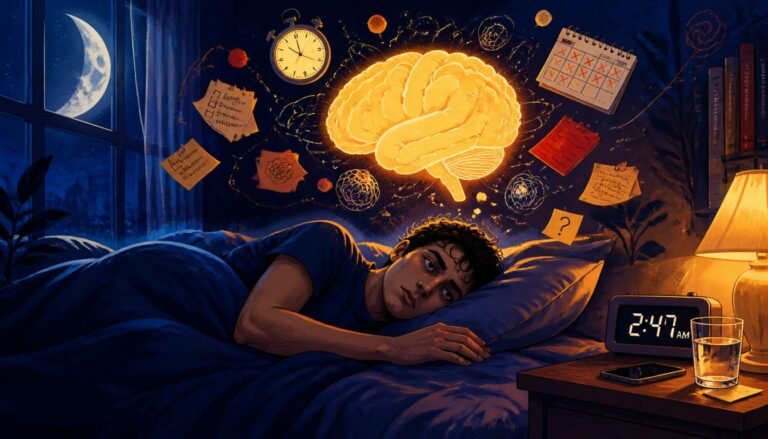


You were asleep an hour ago. Now you’re staring at the ceiling.
It’s 3:07 AM.
You check the clock again, as if you made a mistake checking the time before. You didn’t.
And somehow, this keeps happening.
If you’ve ever wondered why do i wake up at 3 am, you’re definitely not alone. Waking up in the middle of the night is common, and often people briefly wake up several times without ever realizing it. In most cases, they simply drift back to sleep before the brain has had a chance to register the interruption.
Sometimes though you don’t drift back.
You wake up, take note of the time, and suddenly you’re aware that you’re awake. But why 3 am?
Here’s the interesting thing: there probably isn’t anything magical about 3 am itself. Your body doesn’t have a universal alarm that goes off precisely at that hour.
There is something interesting happening to your sleep during the second half of the night though, and your internal body clock is gradually moving towards morning. The things that might barely bother you in the earlier hours can become much more noticeable.
Let’s explore some of these reasons.
First, 3 am Isn’t a Magical Number
The internet and popular culture are full of ideas about waking up at 3 am. There are theories of the body performing some particular task at exactly that hour, or waking at a specific time has a special meaning.
Science is much less dramatic.
There isn’t a universal biological event happening at exactly 3am, and what your body is doing at that moment will depend on when you went to bed, your biological clock, your age, your sleeping habits, and your personal biology.
If you fall asleep at 9pm, 3am comes six hours into your sleep. If you don’t get into bed until midnight it’s only three hours in. These are two very different places to be in the biological night.
Rather than asking “why does my body wake me at 3 am?”, it’s probably more productive to think about why might waking become easier during the second half of the night?
This is where sleep science gets interesting.
Your Sleep is Changing While You Think Nothing is Happening
When you’re asleep, your brain isn’t simply turned off and awaiting reactivation. It’s actually cycling through a pattern of different types of sleep.
Simply put, this means your brain moves between non-REM (NREM) and rapid eye movement (REM) sleep. The non-REM stages consist of progressively deeper levels of sleep, while REM is strongly associated with vivid dreams and distinctive brain activity.
Throughout the night, these two types of sleep cycle in a pattern, but they aren’t identical from beginning to end.
Early in the night you’re more likely to spend substantial time in a deep NREM sleep, but as morning approaches this deep sleep decreases, replaced by longer and more frequent REM periods.
That means your brain at 3 AM isn’t necessarily in the same state as it was at 11 PM.
Think of it like a house at night.
At 11pm, everyone might be deeply asleep and the house is quiet. A small sound from outside may not wake anyone. Later in the night however, the household gradually moves towards morning in sleep, with sleep becoming more active and for some people, easier to interrupt.
A little noise. A change in temperature. Your partner moving around. A full bladder. A stressing thought. Even a little physical discomfort.
Any of these might be enough to take a brief change of sleep into an full awakening.
Researchers sometimes call this sleep fragmentation, where there are interruptions that fragment (break up) otherwise continuous sleep.
The important to note here is that 3 AM may not be causing the awakening but may rather be the time when your changing sleep makes an interruption easier to notice.
Your Body Clock Is Starting to Look Toward Morning
Now we need to introduce in another character in our story, your circadian rhythm.
Your circadian rhythm is your body’s roughly 24-hour timing system which helps coordinate times when you sleep, when you feel awake, your body temp, hormones, metabolism and many other processes.
The biggest cue that helps your circadian rhythm know what time it is however is light.
Your brain uses information about the light-dark cycle to help determine when biological night should start and morning should approach. Melatonin, a hormone associated with the biological night and sleep timing, is part of the system.
During the night, your body is generally in a state that promotes sleep. But it is not stuck there until you open your eyes in the morning.
As the night wears on, your rhythms begin to drift toward the next day’s waking period, until morning light sends your circadian clock into top gear. Recent studies are revealing that the timing of light exposure can shift circadian rhythms, but the amount and speed of the shift depends upon when and how the stimulus is delivered.
This is why it would be misleading to say, cortisol wakes everyone up at 3 am, or your body releases a specific hormone at exactly 3 am in the morning.
Biologically, it’s not that simple.
The truth is that by the second half of the night, your body is approaching its biological morning. This doesn’t mean you should expect to wake up at 3 am. It means your sleep environment, sleep stage, sleep pressure, and circadian rhythms are all interacting differently than they were earlier in the night.
Then Something Minor Wakes You Up
So, why am I always waking up at 3 am?
Sometimes the answer is surprisingly mundane.
Rather than thinking of dozens of possibilities, it’s useful to think of nighttime interruptions in 3 categories.
Something around you
Your sleep environment is more important than you might think.
Traffic, a barking dog, your partner getting up, a phone notification, a hallway light, or the temperature in the room can all disrupt your sleep.
These interruptions don’t necessarily wake you up completely, you may just shift position or briefly become more alert before drifting off again. But if you’re in a lighter or more easily disrupted part of your sleep, the same interruption could cause you to wake up completely.
Something you’re doing
Your daytime, and pre-sleep habits can also play a role in what happens overnight.
Caffeine and nicotine are both stimulants that can interfere with your sleep. Alcohol is a particularly interesting case, as it can make some people feel sleepy later in the day but disrupt their sleep in the night.
A 2024 systematic review and meta-analysis of 27 studies found that alcohol had altered sleep architecture, including delaying and reducing REM sleep with disruptions increasing as the dose of alcohol increased.
More recent reviews also note the increased sleep fragmentation during second-half-of-the-night following alcohol consumption. And then there are a set of less obvious culprits:
- An inconsistent bedtime
- Long or late naps
- Consuming caffeine too close to bedtime
- Evening nicotine
- Sleeping much later on the weekends
- Spending a lot of time engaging in stimulating activities before bed
None of them guarantee you’ll wake at 3 AM, but they can make the nighttime sleep less stable.
Something happening inside you
Sometimes the disturbance is coming from inside your own body.
Pain, acid reflux, needing to urinate, hot flashes, night sweats, hormonal fluctuations, anxiety, or other physical symptoms can interrupt a person’s sleep. Medications can sometimes contribute, too.
This is why the most useful way to think about waking up in the middle of the night isn’t, “what does 3AM mean?”
But what might be interrupting my sleep?
Sometimes 3 AM isn’t the source of the problem. Sometimes it’s the moment you finally realize the thing that is disturbing your sleep.
Why You Can’t Fall Back Asleep After You Wakeup
Here’s where the story gets really interesting.
While the first awakening may have been perfectly fine, the problem can be that you wake up after that, and instead of going back to sleep, you start to do math in your head.
I have to get up at 7.
That’s less than 4 hours away.
I really need to sleep. Why am I awake? Tomorrow is going to be terrible.
And so now you’re not just awake, but you’re monitoring your sleep. This has an impact because sleep is not something we can force ourselves to get, and the more we try to convince ourselves we should be able to fall asleep right this second, the more we can be actively engaged in the process of staying awake and thinking.
Stress and worry are also established contributors to insomnia. NHLBI notes that worrying about not getting enough sleep and watching the clock can exacerbate insomnia.
This can lead to a vicious cycle
Wake up → look at the clock → worry → become more alert → have difficulty sleeping → worry about not sleeping → become even more alert.
And so what was supposed to be a brief awakening (a few minutes) has now become an hour-long ordeal. One of the reasons that behavioral treatments for insomnia target both the sleep and the wakefulness domains is that they aim to interrupt this cycle. Cognitive behavioral therapy for insomnia (CBT-I) is an evidence-based treatment for chronic insomnia. Stimulus control strategies work by breaking the associations between the bed/sleeping environment and wakefulness, frustration, and worry.
What If You Wake Up at 3 AM Every Night?
To begin addressing this concern, ask yourself a surprisingly simple question that many overlook:
Are you waking up at 3 am every night?
It may be that you are only noticing the 3 am because it is the time you check the clock after waking up. You may also wake up at times like 1:47 or 4:12 and go back to sleep without giving it a second thought.
If you’re waking up at 3 am and other strange hours frequently and having trouble falling back asleep, you should investigate the root cause.
Waking up at night can be a symptom of insomnia, circadian rhythm issues, pain, reflux, medication side effects, hormonal fluctuations, stress, and other sleep or health disorders. According to NHLBI, waking up multiple times during the night and waking up too early and not being able to fall back asleep are typical signs of insomnia, especially if they’re linked to daytime issues.
One condition worth knowing about is sleep apnea.
People with sleep apnea may experience pauses in their breathing while they sleep. They may also have other symptoms, such as loud snoring, gasping for air, waking up at night, waking up too early in the morning, being excessively sleepy during the day, or having to pee during the night.
You think that you know what causes these awakenings; however, someone who sleeps alongside you may be more aware of this than you.
The goal is not to suggest that every time you wake up at three in the morning, you have a sleep disorder.
Instead, the intention is to encourage you to investigate potential issues that may arise on a reoccurring basis.
What Should You Actually Do at 3 AM?
Now that you are awake, what should you do?
The goal is not to transform 3 am into a new productive period in your life or engage in some type of pillow fight.
Instead, try to be as unexcited as possible. Don’t stare at the clock because knowing the time can amplify the worry cycle.
Additionally, it is best not to grab your phone because the bright screen and content may make it difficult to fall asleep again.
Try to keep the lighting as low as possible because your body has a strong response to light meaning there is no reason to activate your circadian rhythm at 3 in the morning just to check the time.
Furthermore, allow yourself to fall back asleep. A temporary loss of consciousness is nothing to be alarmed about.
However, there is an exception to this rule.
If you find yourself sitting in bed becoming more frustrated and wide-awake, it may be a good idea to get up and do something quiet in a dimly lit room until you begin to feel tired.
Once this has occurred, you can return to bed.
This is actually the basic principle behind stimulus control, which is a therapeutic strategy that is used in the treatment of insomnia. The key is to make sure that you don’t fight it when you can’t sleep. Instead, work not to turn a brief period of wakefulness into an extended one.
Keep in mind that a single sleepless night doesn’t necessarily mean you have a sleep disorder.
When Should You Stop Blaming the Clock?
The clock isn’t usually to blame.
It’s important to recognize patterns, however. Seek medical advice for chronic loss of sleep if you find yourself waking up often during the night, sleeping for long periods of time or waking up feeling tired, and are often sleepy during the day snore loudly, gasping, or feel like you’re not breathing properly or have pain, indigestion, hot flashes, night sweats, or another symptom that awakens you from sleep and your sleeping habits are interfering with work, school, concentration, mood, sex, or relationships.
The NHLBI recommends talking to a healthcare professional about chronic sleep problems, especially if you’re having daytime sleepiness or impaired daytime function. Keeping a sleep diary for a few weeks may also help identify patterns of sleep loss, including sleep habits, nighttime awakenings, napping, caffeine or alcohol use, and daytime drowsiness.
Conclusion: Maybe 3 AM Isn’t the Problem
Maybe the next time you wake up at 3am, you won’t blame it on your body and mind so quickly.
The architecture of your sleep changes throughout the night. You tend to get deeper stages of sleep early on in the night. As the night progresses, you get more REM and lighter stages until you wake. Your circadian rhythm also moves you towards waking up closer to morning. This can make you more susceptible to being woken up easily during the latter half of your sleep cycle.
Something as small as a noise, warm room, alcohol, stress, a full bladder, pain, heartburn, or even thinking about something can wake you up. And once you’re awake, worrying about it can make it harder to go back to sleep.
So instead of asking “why do I wake up at 3 am?”
Maybe you should be asking “what’s preventing me from going back to sleep?”
That’s not nearly as interesting or mysterious as the first question, but it’s much more helpful to your sleep in the long run.