
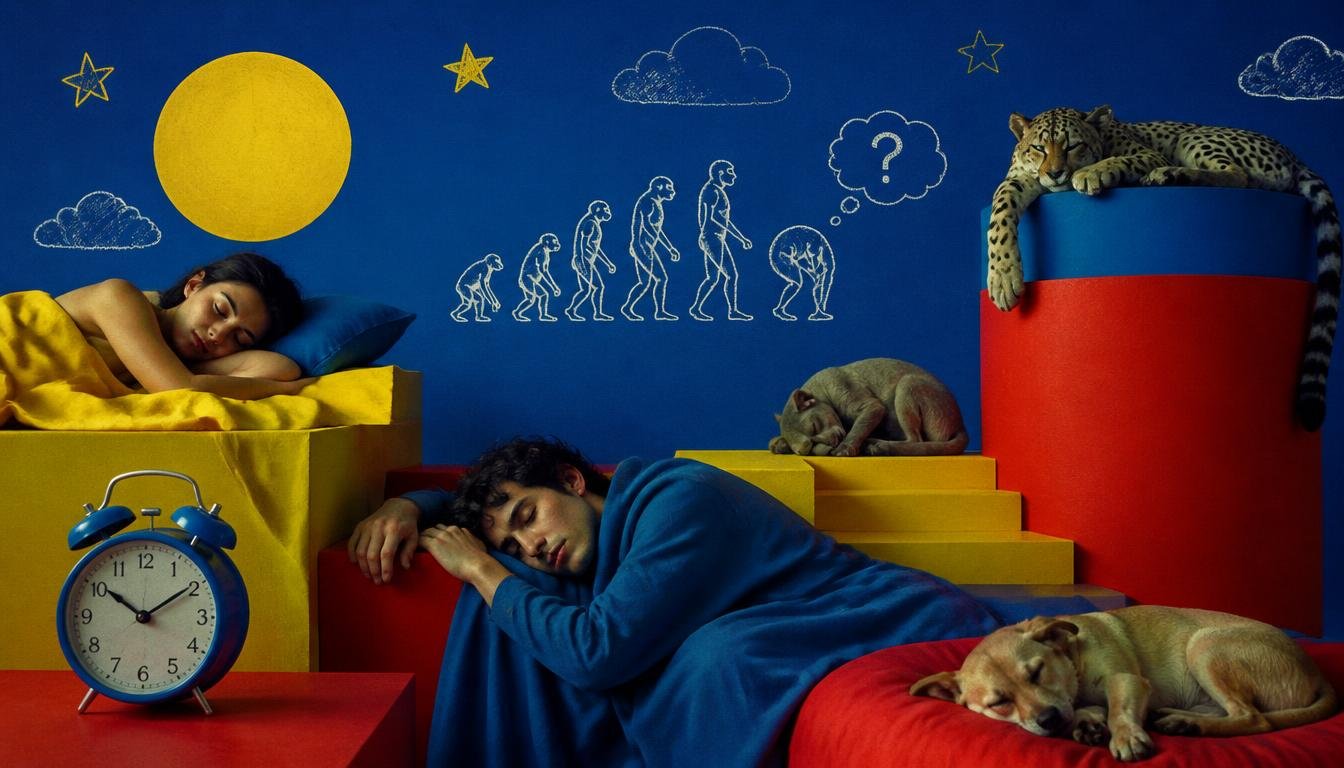

Every night, you become unconscious of your surroundings and lose opportunities to mate, find food, or respond to potential threats.
And even after realizing, you would continue doing it, but why?
Sleep has been one of the biological mysteries that made scientists scratch their heads. Multiple theories have been proposed to explain why do we sleep and researchers successfully revealed multiple functions occurring during sleep but they don’t really explain sleep’s evolutionary origin. Sleep is closely intertwined with an organism’s physiology and influences body’s restorative and repair mechanisms. Evolution of sleep as core function with variations amongst species, does inform us that avoiding sleep completely is not a choice. Though, recent developments in sleep science are transforming it into a fascinating area of inquiry.
Why Would Evolution Make Us Unconscious?
To answer the question, ‘why do we sleep?’ we need to address what sleep actually does and why was it evolved to begin with. Scientists have efficiently found thorough evidence on impacts of sleep including memory consolidation, tissue repair and physical healing, immune regulation and metabolism. However, the reason for its evolutionary origin is puzzling.
Sleep is seemingly a vulnerable state you can be in, so why has natural selection continued to favor it through life history? Multiple physiological processes occurring during sleep state, although essential for livelihood, still do not explain the need to be unconscious and raises the question on why evolution favors a trait that negates the requirement for survival.
The Hidden Costs of Sleep
Sleep is not just an innocuous state of inactivity but it restricts you from performing tasks that you easily fulfil during daytime. While sleeping, you are:
- Unable to perform mundane tasks
- Exposed and unaware of your surroundings
- Unable to replenish energy reserve from food
- Unable to mate or reproduce
- Unable to respond to potential danger
Considering the numerous restrictions due to sleep, why would evolution preserve a trait that is seemingly a threat to survival to begin with?
Could Sleep Have Started as a Survival Strategy?
What if sleep serves as a defense mechanism? Looking from an evolutionary aspect, researchers proposed a compelling theory, conventionally known as adaptive inactivity/energy conservation theory:
During sleep state, animals can reduce their energy expenditure as a consequence of decreased activity. Their metabolic activity also drops since activity at nighttime is unfavorable. It highlights sleep’s preservative properties and suggests it to be a survival strategy for organisms to use their limited energy reserve only when it’s needed. It makes a compelling evolutionary argument but still does not portray a complete picture.
Additionally, nighttime offers less opportunities of livelihood as darkness limits vision and access to food or other resources which justifies inactivity. The hypothesis is further reinforced by the observed variations in sleep duration among different species according to their local ecology like diet and seasonal patterns. The theory makes a strong connection that organisms need to protect themselves from danger by hiding, enabling them to limit energy usage and keep reserves but it does not exactly explain why it requires us to be unconscious. Adaptive inactivity explains why staying inactive at unfavorable times can be useful and energy conservation further elaborates why limiting energy consumption could be beneficial.
This bring us to another question: If staying inactive at certain periods advantageous then why can’t we just stay awake but inactive? To explore this question, it is important to understand what actually happens inside the body during sleep state.
What Does Sleep Actually Do?
Multiple biological processes occur during sleep that influence body’s capability to rest, restore and repair itself.
Sleep Helps the Brain Learn and Remember
Wondering how sleep can influence your ability to remember?
Well, sleep plays a major role in learning and memory. One impactful hypothesis, known as synaptic homeostasis, proposes that sleep can regulate strengthening of neuronal connections (connections between brain cells) to reinforce memory.
You are exposed to sea of information during the day that increases activity between neurons in the brain. The synaptic activity continuously reshapes the brain through neuroplasticity but continued activity can be exhaustive and energetically expensive for the brain. Through synaptic homeostasis, sleep downscales this activity at an energetically sustainable level. Downscaling preserves the connections that are reinforced during the day while weaker connections are further attenuated. In other words, sleep helps brain decide what information is worth keeping and what needs to be discarded. This means that you will remember the presentation you rehearsed many times but probably won’t remember what your neighbor was wearing yesterday.
Although it is a well-established fact that sleep promotes memory building and synaptic plasticity but there’s a catch; it still does not explain its origin. Sleep function is experienced by wide range of organisms including those with varying nervous systems implying that memory cannot be the only reason for its evolution.
Sleep Supports Physical Recovery
Sleep has a direct correlation with the body’s ability to heal and repair. During sleep, growth factors (molecules that stimulate regeneration and growth) are released in high concentrations that promote protein synthesis, tissue growth, and overall repair.
In a fascinating clinical trial, young adults were restricted to 2-hour sleep for 3 days. Wound healing was delayed by 1 day in sleep deprived adults as compared to normally slept adults suggesting that sleep deprivation significantly decreases healing of skin barrier. Another study showed 18% decrease in skeletal-muscle protein synthesis that aid muscle repair by only 1 night of sleep deprivation.
Additionally, sleep sustains inflammatory balance in body since low inflammation hinders injury healing while high inflammation damages tissues. Sleep has massive impact on hormone and immune system for rapid healing as well however, this isn’t an adequate answer for the evolution of sleep since these processes are in action during the day as well.
Sleep Regulates the Immune System
Notably, sleep influences both innate as well as adaptive immunity to regulate and reinforce immune defense. Immune cells that fight pathogens are redistributed and regulated throughout the body and antibody production is promoted to strengthen body’s defenses. Immune memory is also strengthened by making reserves of memory cells. This is especially useful if you have recently been vaccinated or fought a viral disease.
A good night’s sleep reforms your defense barriers and prevents you getting sick from the same pathogen again quickly. Strengthening the immune function can still not be the sole reason for the evolution of sleep but quite possibly a mere secondary function since an organism’s immune system is active during daytime as well.
Does Sleep Really Help Clear Waste From the Brain?
Multiple convincing connections has been established between sleep and its effects on the brain. One fascinating hypothesis is that the space between brain cells increases during sleep, allowing more interstitial fluid to surround them. This facilitates the removal of certain metabolic waste products and toxins from the brain. The suggested ‘glymphatic’ function, of removing metabolic waste, has attracted considerable attention from researchers however, its significance is still under investigation.
Removal of toxins and metabolic waste seems a beneficial function for an organism’s well-being but it has certainly not been proven as the standalone reason for evolution of sleep.
So what happens when you take away sleep? Would these processes continue to occur without sleep?
Prime Lead: What Happens When Sleep Is Taken Away?
Sleep deprivation has an immensely detrimental impact on various aspects of an organism’s physiology. Sleep loss is broadly associated with:
- Decreased attention span and difficulty remembering
- Mood instability
- Cardiovascular issues
- Hormonal dysfunction
- Metabolic disorders
- Compromised immune function
Sleep is broadly associated with major physiological and behavioral functions which is enough to inform that you cannot just avoid sleeping entirely. Repercussions of sleep deprivation highlight its importance for a healthy lifestyle but do not clarify its evolutionary emergence.
Why Do Animals Sleep So Differently?
Variation in sleep function across species indicates that sleep function has evolved in response to local ecological factors that enable them to thrive in their respective niches.
Multiple factors differentiate sleeping patterns amongst species that may include:
- Predation risk
- Habitat
- Body size
- Metabolism
- Feeding patterns
- Social behavior
Evolution has preserved sleep as a universal phenomenon however, sleep pattern differ considerably among species.
So Why Has Evolution Preserved Sleep?
Sleep is not just a state of dormancy rather complex physiological processes occur during sleep that restore, repair and sustain an organism’s biological machinery.
The research does not disclose one definite reason for the evolution of sleep but it does reveal something interesting: sleep pattern is profoundly affected by an organism’s morphology and environment. One important insight may be that preservation of sleep function may not have one single advantage. Organisms seem to have adapted their sleep patterns according to their environments that helps them steer in threatening situations when staying active is disadvantageous.
Is There One Evolutionary Purpose of Sleep?
The information we’ve gathered so far makes us question whether sleep has one evolutionary purpose and others are added consequences or not. Scientists could not reach to concluding point however, research has unraveled multiple mysteries related to sleep:
- Why sleep may have evolved?
- What sleep does?
- Why sleep deprivation is harmful?
- Why different animals have different sleep patterns?
Why Do We Need to Sleep at All?
Coming back to the big question—why we sleep at all?— research still doesn’t have a definite answer. Though, it did clarify that sleep is a biologically active state when complex processes occur namely physical recovery, memory strengthening, immune regulation and waste clearance.
These answers address the question of what sleep does but don’t shed light on its evolutionary origin.
Perhaps sleep does not have one evolutionary purpose. It is a biological process that evolved for different species with varying physiological needs and environments. Extensive research on the topic of sleep makes it evident that it is a far more intricate phenomenon than a straightforward answer might suggest.
Radical Possibility: What If Sleep Is About Two Different Worlds?
Two thought-provoking theories propel us to continue the search for a definitive answer.
One interesting theory proposed by Andrew S. Freiberg suggests that day and night already exists as two ecological niches and organisms are only adapting to the two niches. Commonly known theory of energy allocation also indirectly supports the two-niche theory as it suggests that organisms utilize their limited energy reserve according to their ecological needs; energy consumption is higher in daytime due to higher requirements while at nighttime, usage is lower due to decreased activity. In other words, organisms adjust their physiological processes according to the environmental needs.
Another theory suggests that unconsciousness may be a consequence of prevalence of local sleep in the brain rather than being sleep itself. Sleep can be evoked in some parts of the brain known as the local sleep. When local sleep is experienced in enough parts of the brains, interaction with the environment becomes impossible similar to unconsciousness.
Sleep makes us defenseless to external environment however, it has been preserved since life history. This may be the most convincing clue that it does matter tremendously.

[…] isn’t simply a state of dormancy when your brain completely switches off and turns on again at sunrise. Throughout the night, you go […]
[…] Why do we sleep at all? […]
[…] of sleep as more of a train with lots of stops, rather than a switch with one on/off […]